
No matter how experienced you are in apparel production, every manufacturing project starts with one key discussion: the apparel manufacturer MOQ.
But what is MOQ?
MOQ stands for minimum order quantity, and it determines the smallest number of units a manufacturer will agree to produce for you.
At Innovate Apparel, we talk to brands every week who assume MOQ is a single, fixed number. In reality, it is a layered system that affects fabric, colors, sizes, and pricing all at once.
This guide walks through all you need to know about apparel manufacturer MOQ.
What Does Apparel Manufacturer MOQ Mean?
MOQ is the minimum quantity a manufacturer needs to produce in order to make a production run worthwhile. Factories set this number based on machine setup time, fabric cutting efficiency, and labor scheduling.
Producing 20 pieces often costs a factory nearly as much time and setup as producing 300. So most manufacturers set a floor that protects their production line from losing money on small runs.
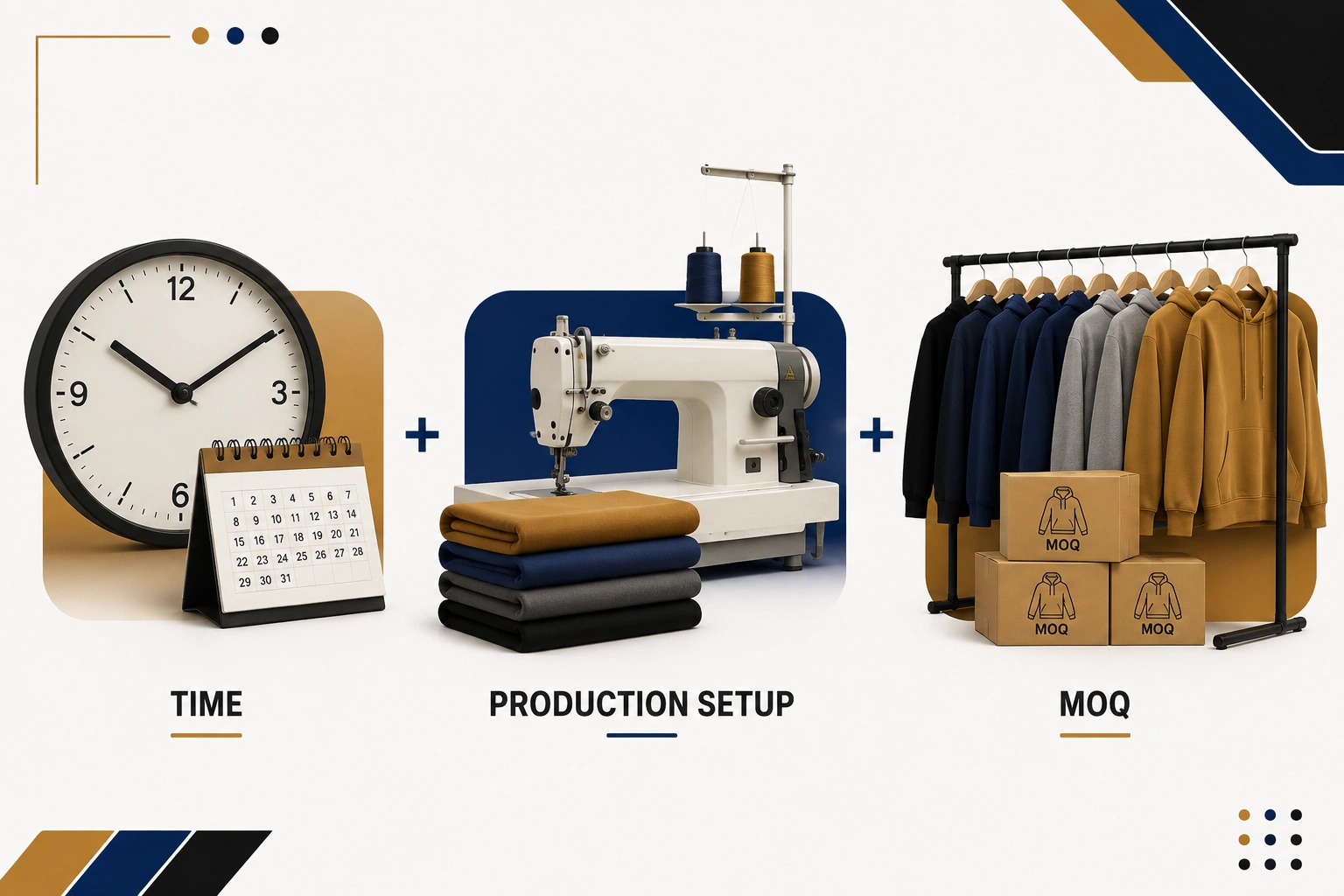
Manufacturers set MOQs for a few practical reasons.
- Production setup costs: Preparing cutting tables, machines, and production lines requires time and resources, regardless of whether the order is for 50 or 500 pieces.
- Material sourcing requirements: Fabric mills and trim suppliers often have their own minimum purchase quantities, which can influence the factory’s production minimum.
- Production efficiency: Larger batches help factories maintain a consistent workflow, reduce downtime between orders, and improve overall efficiency.
- Cost distribution: Fixed costs such as pattern setup, machine adjustments, and quality checks can be spread across more garments, helping keep the cost per unit lower.
- Capacity planning: Factories schedule production in advance and use MOQs to balance workloads while meeting delivery deadlines for multiple clients.
The Different Types of MOQ You May Encounter
When a factory says “our MOQ is 300 pieces,” that sentence is incomplete until you know which type of MOQ they mean. A 300 piece MOQ could apply to your total order, to each style, to each color, or to each size.
The financial difference between these interpretations is significant.
- Product MOQ refers to the minimum quantity required for a single product design, regardless of how many colors or sizes you break it into. If the factory quotes a product MOQ of 300, that usually means 300 total units of that one style.
This is the most commonly understood term when someone says this quantity is the MOQ. The others, not so much unless specified. A person who works in the apparel manufacturing industry knows the difference; an ordinary potential client doesn’t.
- Style MOQ applies when you are ordering multiple designs in the same collection. A factory might require a separate minimum for each style, so five styles at a 100 piece style MOQ means 500 units total.
- Color MOQ sets a minimum for each individual colorway within a style. If a shirt is offered in three colors and the color MOQ is 100, you need to order at least 100 of each color to qualify.
- Size MOQ works the same way but applies to size breakdowns. Some factories require a minimum quantity per size, which limits how thin you can spread your sizing across small, medium, and large.
- Fabric MOQ is set by the mill or fabric supplier rather than the garment factory itself, and it is measured in meters or yards rather than finished units. This number can override everything else, which is explained in more detail in the next section.
- Trim MOQ applies to items like zippers, buttons, labels, and drawcords. Custom trims often carry their own minimum order requirements separate from the garment itself.
- Total Order MOQ is the combined minimum across your entire purchase order, which may include multiple styles, colors, and sizes added together rather than counted separately.
MOQ Type | What It Controls | Example |
Product MOQ | Total units of one design | 300 pcs of one hoodie style |
Style MOQ | Minimum per design in a collection | 100 pcs per style, 5 styles |
Color MOQ | Minimum per colorway | 100 pcs per color |
Size MOQ | Minimum per size | 50 pcs per size |
Fabric MOQ | Minimum fabric yardage from the mill | 500 meters |
Trim MOQ | Minimum for custom trims and labels | 1,000 woven labels |
Total Order MOQ | Combined minimum across the whole order | 500 pcs across all styles |
What Determines an Apparel Manufacturer's MOQ?
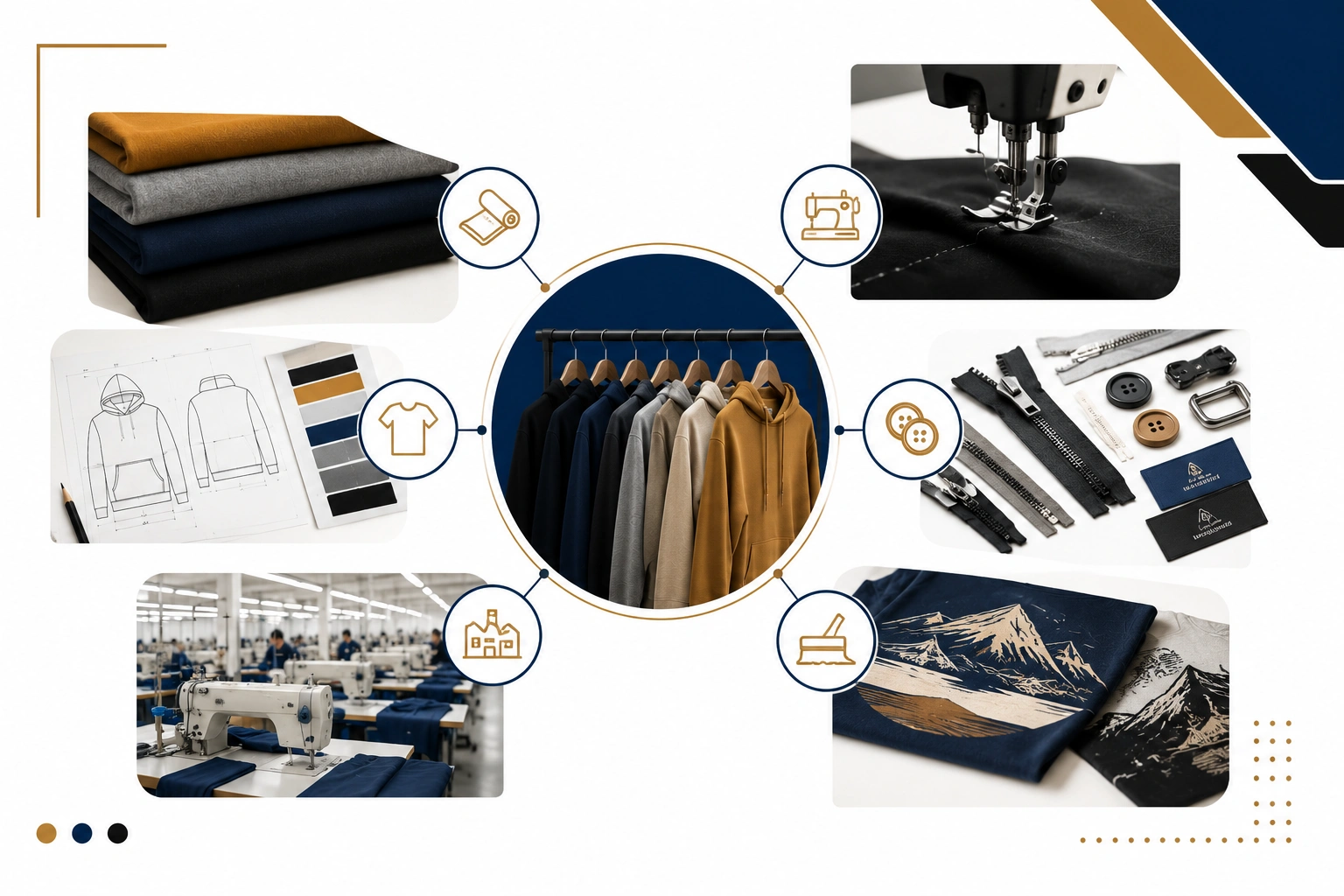
MOQ is not an arbitrary number a factory picks. It comes from real production variables, and understanding them helps you see why two factories making similar products can quote very different minimums.
Fabric sourcing plays a major role because factories that keep certain fabrics in stock can offer lower minimums, while factories that need to order custom or specialty fabric are bound by the mill’s own minimum yardage.
Garment complexity affects how much setup and labor a style requires. A basic t-shirt needs far less machine time than a structured jacket with multiple panels, linings, and closures, so complex garments typically carry higher MOQs to justify the setup work.
Custom trims and branding, including woven labels, custom buttons, or specific hardware, often require their own supplier minimums, which can push your overall MOQ higher even if the garment itself is simple.
Printing and embroidery methods matter too. Screen printing and embroidery machines both need setup time for each design, so factories usually require a minimum run to make that setup worthwhile.
Factory size and specialization explain why MOQs vary so widely between suppliers. A large factory with dozens of sewing lines is optimized for scale and may require thousands of units, while a small specialty workshop might comfortably produce 50 units because its entire operation is built around shorter runs.
You might want to take a look at the top 10 hoodie manufacturers too in case you are planning to start a hoodie brand.
How MOQ Impacts Pricing
Order Quantity | Estimated Unit Cost |
50 pcs | $18.00 |
100 pcs | $14.00 |
300 pcs | $11.00 |
1,000 pcs | $8.00 |
Don’t consider these as the benchmark of apparel manufacturing. Actual pricing depends on your specific garment requirements.
Fixed costs like fabric cutting, machine setup, and sampling get spread across more units as your order grows, which brings your per unit price down.
This is why factories often present higher MOQ options as more cost effective per piece, even though the total upfront investment is larger.
MOQ vs Fabric Minimums: Why They're Not Always the Same
This is one of the most common points of confusion for new brands, and it deserves its own explanation because it can override every other MOQ discussion you have with a factory.
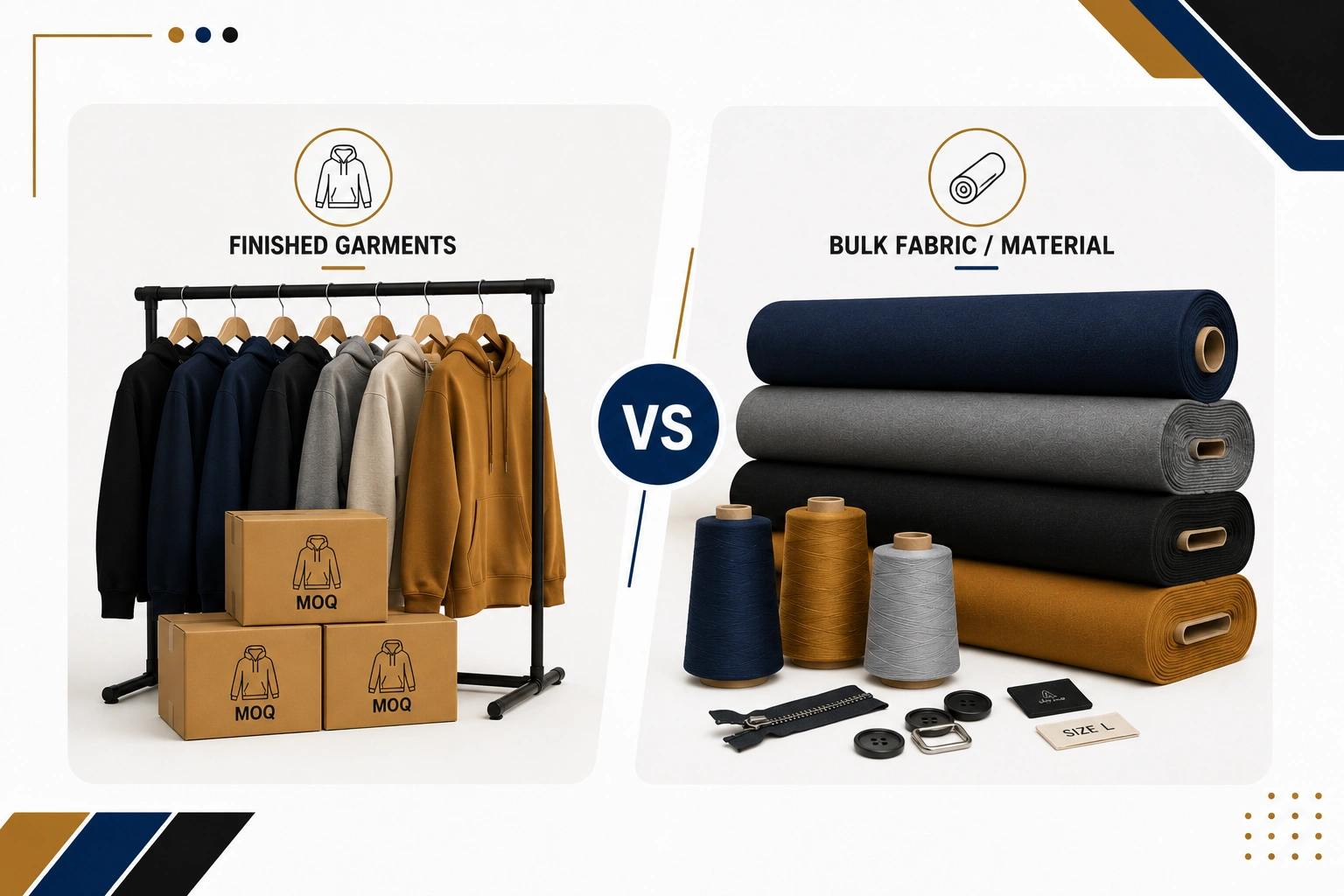
A garment factory might be perfectly willing to produce 100 pieces of your design. That is their factory MOQ. But if your design uses a fabric that has to be sourced or woven specifically for your order, the fabric mill may have its own minimum, often measured in meters rather than finished garments.
In practice, the fabric MOQ wins whenever it is higher than the garment factory’s MOQ. This is why a factory can quote a low garment minimum, and you can still end up needing to place a much larger order once fabric requirements are factored in.
Low MOQ vs High MOQ: Which Is Better?
Low MOQ | High MOQ |
Lower upfront investment | Lower unit cost |
Easier to test new products | Better economies of scale |
Less inventory risk | Priority scheduling with the factory |
Faster design iteration | Stronger long term production efficiency |
Low MOQ suits brands that are still validating a product idea, testing a new market, or working with limited startup capital. High MOQ suits brands with proven demand, established sales channels, and the storage capacity to hold inventory while benefiting from a lower per unit cost.
Neither option is universally better. The right choice depends on your sales history, cash flow, and how confident you are in the design.
Can You Negotiate an Apparel Manufacturer's MOQ?
MOQ is often more flexible than brands assume, especially once you understand what actually drives the number for that factory. Instead of simply asking a factory to lower its MOQ, it helps to offer something that reduces their cost or risk in return.
Instead of asking “can you lower the MOQ,” try asking questions like these:
- Can we use a fabric you already keep in stock?
- Can we combine two styles to share the same fabric order?
- Can I pay a higher unit price in exchange for a smaller quantity?
- Can the order be split into multiple smaller deliveries?
- What would the MOQ look like for a repeat order?
These questions give the factory room to say yes because they address the actual cost driver behind the minimum.

Common MOQ Mistakes and Red Flags
New brands often make the same mistakes when navigating MOQ for the first time. Keep these points in mind before committing to an order:
- Choosing the lowest MOQ: A smaller order may come with a higher unit price, making the product harder to sell profitably.
- Ignoring fabric minimums: A low garment MOQ means little if the fabric or material supplier requires a much larger minimum.
- Ordering too many SKUs: Spreading your quantity across too many colors and sizes can make it difficult to meet individual MOQs efficiently.
- Skipping samples: Saving time on samples can lead to fit, fabric, or production issues that are much more expensive to fix after bulk production begins.
- Over-ordering for a discount: A lower unit price is not always a better deal if you end up paying for excess inventory and storage.
- Overlooking supplier transparency: Before placing a large order, make sure the factory can clearly explain its MOQ, pricing, materials, production process, and payment terms.
The right MOQ is ultimately a balance between production costs, cash flow, and how confidently you can sell the finished product. Rather than choosing the smallest or largest quantity, look at the full cost of the order, confirm the supplier’s requirements, and make sure the quantity fits your current demand.
Taking this approach gives you a stronger starting point for production and reduces the risk of tying up money in inventory you cannot move.
Make Apparel Manufacturer MOQ Work for Your Business
We can acknowledge that, by now, an apparel manufacturer’s MOQ is a reflection of production costs, material sourcing, and manufacturing efficiency and it isn’t just a standard number. You can now make better sourcing decisions and avoid costly surprises.
Before choosing a manufacturing partner, take the time to clarify how their MOQ applies, whether it can be adjusted based on your project. A well-informed approach can help you manage costs, reduce inventory risk, and build a stronger foundation for your clothing brand.
Innovate Apparel is here to guide you through MOQ requirements and recommend the most practical production solution for your needs.
Contact us today to discuss your project and receive a customized manufacturing quote.