
Looking for a custom clothing manufacturer near me usually means you want more than a supplier directory.
You need a manufacturer that can understand your product, develop samples, meet your quality requirements, handle your quantity, and deliver within a realistic timeline.
That raises a bigger sourcing question:
Should you manufacture locally, or work with an overseas apparel manufacturer?
Local production can make sense when you need faster communication, hands-on development, smaller production runs, or a tight launch schedule. Overseas manufacturing can make more sense when you have proven products, larger quantities, specialized production requirements, or a strong focus on unit economics.
The right answer depends on your product and order.
This guide explains how to find a custom clothing manufacturer, compare local and overseas production, and decide when a hybrid manufacturing strategy makes sense.
Custom Clothing Manufacturer Near Me: What Are You Actually Looking For?
The phrase “custom clothing manufacturer near me” can describe several very different businesses.
Some companies manufacture garments from your specifications. Others sell existing blanks, decorate ready-made apparel, or provide print-on-demand fulfillment.
Knowing the difference saves time because each production model gives you a different level of control.
Manufacturing Model | What You Control | Best For |
Custom cut-and-sew manufacturer | Fabric, pattern, fit, construction, trims, branding | Original apparel designs |
Private-label manufacturer | Existing or developed styles plus branding | New clothing brands |
Full-package manufacturer | Development through production | Brands wanting one production partner |
CMT manufacturer | Cutting, making, and trimming | Brands that already source materials |
Small-batch manufacturer | Custom production at smaller quantities | Startups and product testing |
Blank supplier | Usually limited to existing garments | Basic apparel and decoration |
Print-on-demand provider | Graphics and fulfillment | Testing designs without inventory |
Apparel decorator | Printing, embroidery, or embellishment | Existing garments |
The distinction becomes important when you compare quotes.
A $10 decorated blank and a $15 custom cut-and-sew garment do not offer the same product.
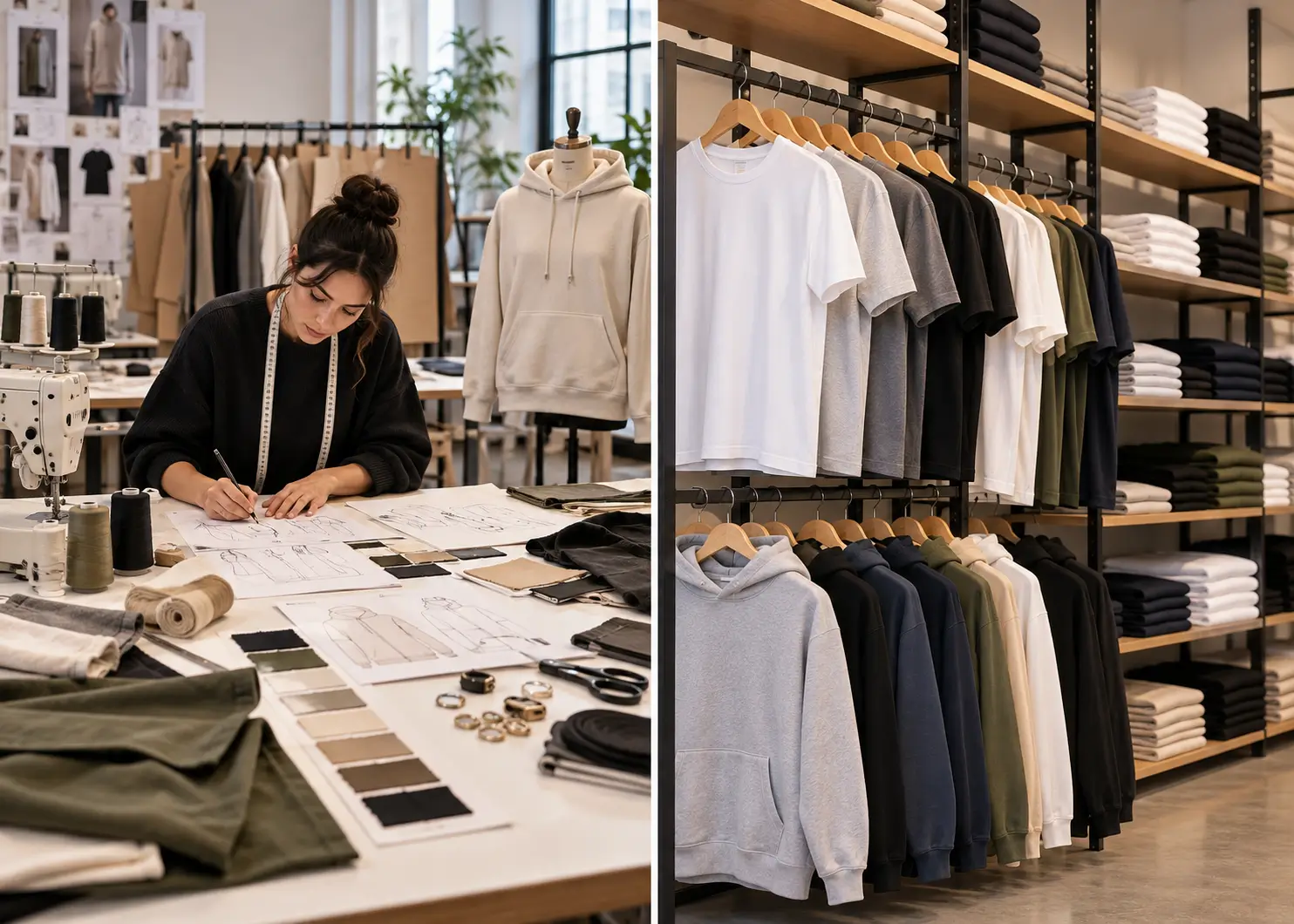
Custom Manufacturer vs Blank Supplier
A blank supplier sells an existing garment.
You may be able to add:
- Your logo
- Screen printing
- Embroidery
- Labels
- Tags
- Packaging
But the underlying garment already exists.
A custom clothing manufacturer can develop the garment around your specifications. You can define the fabric, measurements, fit, construction, trims, colors, branding, and finishing.
Innovate Apparel, for example, publicly lists cut-and-sew, private-label, custom printing, custom finishing, and custom apparel manufacturing services.
Custom Manufacturer vs Print-on-Demand
Print-on-demand works well when you want to test graphics without purchasing a large inventory.
It usually gives you less control over:
- Fabric
- GSM
- Pattern
- Fit
- Construction
- Trims
- Garment washing
- Custom packaging
- Manufacturing specifications
A custom manufacturer gives you greater product control.
That difference matters when your garment itself forms part of your brand identity.

Local vs Overseas Custom Clothing Manufacturer: What Changes?
The local vs overseas apparel manufacturer decision usually comes down to five major variables:
Cost, speed, quantity, control, and scalability.
Neither production model automatically wins.
Factor | Local Manufacturer | Overseas Manufacturer |
Unit production cost | Often higher | Often lower at appropriate volumes |
MOQ | May offer more flexibility | Can increase with factory and material requirements |
Sampling | Usually easier to coordinate | International shipping adds time |
Communication | Same or closer time zone | Time-zone differences may apply |
Factory visits | Usually easier | More difficult and expensive |
Shipping | Shorter domestic route | International freight required |
Import duties | Usually simpler | May apply |
Quality inspection | Easier to perform personally | Requires stronger inspection systems |
Product development | Faster physical iteration | Can take longer across borders |
Scalability | Depends on manufacturer | Many overseas hubs support high-volume production |
Inventory risk | Can suit smaller runs | Larger MOQs can increase exposure |
Best fit | Development, smaller runs, urgent launches | Proven products and larger production runs |
These are general tendencies.
Your actual experience depends on the manufacturer, product, order quantity, shipping method, materials, and production requirements.
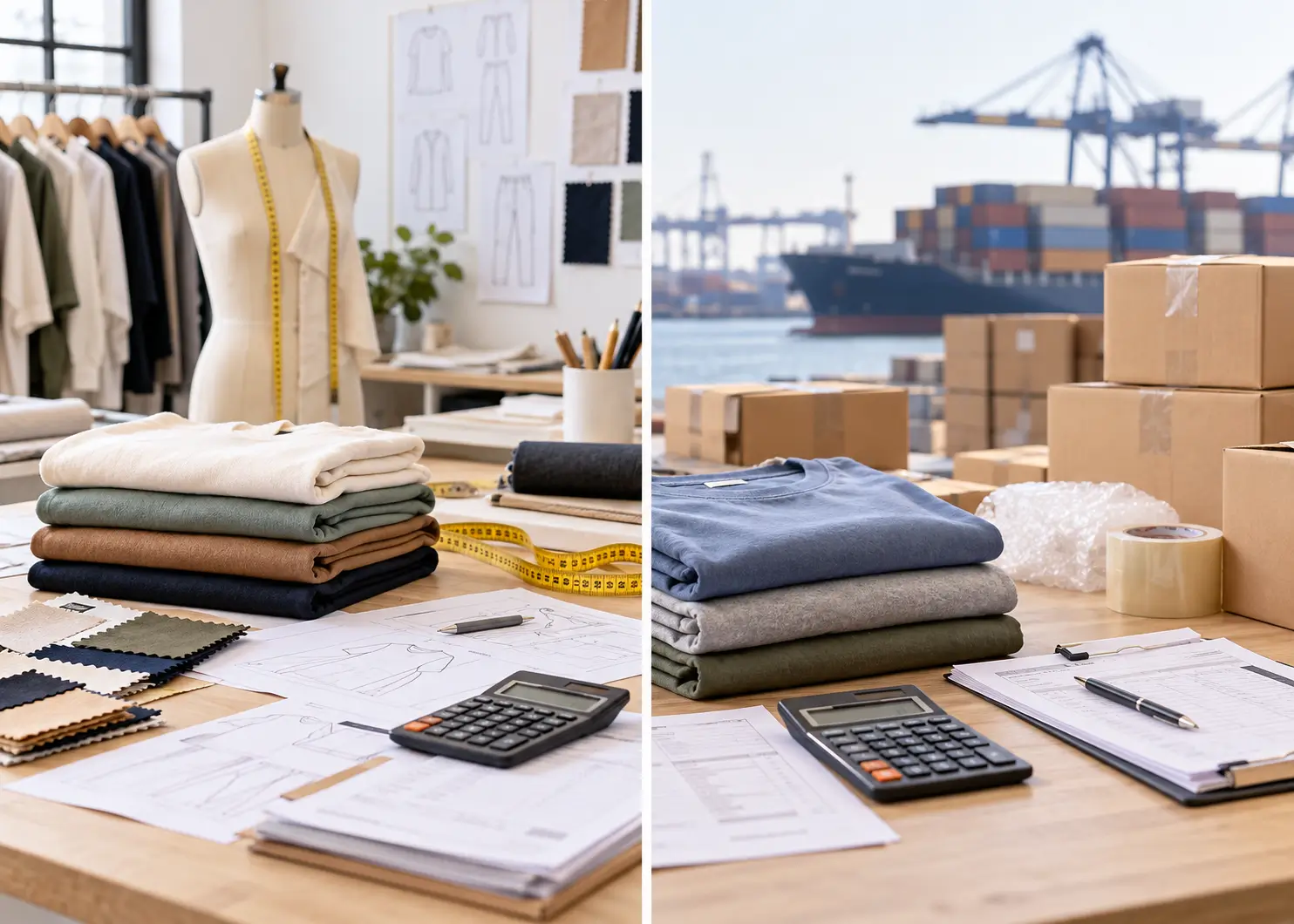
USA vs Overseas Clothing Manufacturing: The Real Cost
The biggest mistake in apparel sourcing is comparing factory prices alone.
A manufacturer may quote a lower unit price overseas, but that number does not represent your final cost.
You need to calculate landed cost.
Unit Cost vs Landed Cost
A useful starting formula is:
Landed Cost = Production + Sampling + Freight + Duties/Taxes + Inspection + Rework + Other Import Costs
For domestic production, the formula may become simpler because international freight and import-related costs may disappear.
For overseas production, those costs can materially change the final economics.
Why a Lower Unit Price Can Cost More
Imagine two manufacturers quote your garment.
Manufacturer A
- Lower factory price
- Higher MOQ
- International freight
- Import duties
- Longer inventory commitment
Manufacturer B
- Higher factory price
- Lower MOQ
- Shorter shipping distance
- Smaller initial order
Manufacturer A may look cheaper on the quotation. Manufacturer B may reduce your total financial exposure. The right comparison uses the entire order economics.
Why MOQ Changes the Economics
Consider how your decision changes at different quantities:
- 50 units
- 100 units
- 250 units
- 500 units
- 1,000 units
- 5,000+ units
A production model that works for 5,000 pieces may make little sense for 50. And a factory designed for large-scale production may not provide the flexibility a new brand needs.
Which Is Faster: Local or Overseas Apparel Manufacturing?
Turnaround does not begin when the factory starts sewing.
It starts when you submit the project.
A realistic production timeline can include:
Inquiry → Quote → Tech-pack review → Fabric sourcing → Pattern development → Sampling → Revisions → Approval → Bulk production → Quality control → Shipping → Delivery
Every stage can affect your launch date.

Local Production Timeline
A local production project may involve:
- Initial inquiry
- Quote
- Technical review
- Fabric sourcing
- Pattern development
- Sample production
- Fit revisions
- Pre-production approval
- Bulk production
- Quality control
- Domestic shipping
The biggest advantage comes from physical proximity.
If the sample needs another revision, you may resolve the issue faster.
Overseas Production Timeline
An overseas project follows many of the same steps.
International production can add:
- International sample shipping
- Time-zone differences
- Longer communication cycles
- Factory scheduling
- International freight
- Customs clearance
- Port delays
- Import processing
- Additional inspection
That does not make overseas production inherently slow.
A mature overseas manufacturer with strong processes can produce at scale efficiently.
You simply need more planning around the complete timeline.
Why Reorders Change the Calculation
Your first order requires development.
A reorder can use:
- Approved pattern
- Approved fabric
- Approved measurements
- Approved trims
- Approved colors
- Approved packaging
- Approved production specifications
That can make repeat production considerably easier to manage.
This is why a manufacturer that seems slower during development can become highly efficient once your product reaches a stable production stage.

When a Local Clothing Manufacturer Makes More Sense
Local production can provide meaningful advantages for specific situations.
You’re Launching Your First Collection
First collections involve uncertainty.
You may still need to refine:
- Fit
- Fabric
- Measurements
- Construction
- Colors
- Packaging
A nearby production partner can make those revisions easier to coordinate.
Your Product Still Needs Development
Custom products rarely emerge perfectly from the first sample.
You may need several rounds of:
- Fit adjustments
- Pattern changes
- Fabric changes
- Trim changes
- Construction changes
Physical proximity can simplify those conversations.
You Have a Fixed Launch Date
Local production can make sense when you have a firm deadline for:
- A pop-up
- A trade show
- An event
- A collaboration
- A seasonal collection
- A retail launch
You still need to confirm the manufacturer’s actual lead time.
Do not assume local production automatically means fast production.
You Need Frequent Reorders
A shorter supply chain can help when your business depends on quick replenishment.
That can matter for products with:
- Fast sell-through
- Seasonal demand
- Frequent launches
- Limited inventory
- Short promotional windows
You Want Hands-On Quality Control
Local production makes factory visits easier.
You may be able to inspect:
- Samples
- Production
- Fabric
- Construction
- Finishing
- Packaging
You can also build a closer working relationship with the production team.
You Want Domestic Manufacturing Positioning
Some brands want domestic manufacturing as part of their positioning.
If you plan to make a specific origin claim such as “Made in USA,” verify the applicable legal requirements before publishing that claim.
Manufacturing location and marketing language need to align.
When Overseas Manufacturing Makes More Sense
Overseas manufacturing can become increasingly attractive as your production requirements change.
You Have High Production Volumes
Large production runs can spread development and setup costs across more units.
A proven product with predictable demand may benefit from a manufacturing ecosystem built for scale.
Your Product Is Already Proven
A stable garment gives you fewer development variables.
You already know:
- The fit
- Fabric
- Construction
- Size breakdown
- Color demand
- Customer response
That makes larger production runs easier to forecast.
Your Primary Goal Is Unit-Cost Reduction
Overseas manufacturing can provide lower production costs at appropriate volumes.
But compare the landed cost, not the factory quotation.
A lower factory price does not automatically produce a lower final cost.
You Need Specialized Production
Some international manufacturing hubs have deep expertise in specific categories.
Depending on the region and factory, that can include:
- Knitwear
- Denim
- Activewear
- Sportswear
- Technical fabrics
- Embellishment
- Large-volume basics
The manufacturer’s specialization matters more than the word “overseas.”
You Have Enough Lead Time
International production works best when your business can plan ahead.
Give yourself room for:
- Development
- Sampling
- Approval
- Production
- Inspection
- Freight
- Customs
- Delivery
If you need garments next week, an international production strategy probably does not fit the project.
When Local vs Overseas Manufacturing Is Not an Either-Or Decision
Many brands assume they must choose one production model.
You do not always have to.
A hybrid manufacturing strategy can combine local development with overseas scale.
Develop Locally, Scale Overseas
A possible workflow looks like this:
Prototype → Sample → Fit → Validate Demand → Scale
You can develop and test the product closer to home.
Once demand becomes predictable, you can evaluate larger-scale production.
Keep New Styles Local, Move Proven Styles Overseas
This approach works well for brands with different product stages.
For example:
- New hoodie → Local production
- Limited-edition jacket → Local production
- Proven basic T-shirt → Overseas production
- High-volume sweatshirt → Overseas production
The production model follows the product’s maturity.
Use Different Manufacturers for Different Products
You can also build a multi-manufacturer strategy.
For example:
Product | Possible Production Model |
New fashion sample | Local |
Limited-edition collection | Local |
Proven basic tee | Overseas |
High-volume hoodie | Overseas |
Urgent restock | Local |
Seasonal bulk collection | Overseas |
That approach can give a growing brand more flexibility.
Quality Control: Local vs Overseas
One of the weakest assumptions in apparel sourcing is: Local manufacturing automatically means better quality. It does not.
Geography does not guarantee quality. Production controls do.
What Actually Determines Garment Quality?
Look at:
- Pattern accuracy
- Fabric consistency
- GSM
- Stitching
- Seam construction
- Measurements
- Shrinkage
- Color consistency
- Printing
- Embroidery
- Trims
- Finishing
- Final inspection
A strong manufacturer should have a process for checking these details.
Quality Control With a Local Manufacturer
Local production can make physical inspection easier.
You may be able to:
- Visit the facility
- Inspect samples
- Review production
- Discuss defects directly
- Approve revisions in person
That provides a practical advantage.
Quality Control With an Overseas Manufacturer
International production requires stronger documentation and process control.
Use:
- Detailed tech packs
- Approved samples
- Written specifications
- Measurement charts
- Material specifications
- Pre-production approval
- Inspection standards
- Pre-shipment inspection
- Third-party inspection when appropriate
The goal remains the same.
Produce the approved garment consistently.
Shipping, Customs and Supply Chain Risk
Shipping can completely change an apparel sourcing decision.
A local manufacturer may send your finished garments through domestic freight.
An overseas order may involve:
Factory → Export documentation → Port → International freight → Import customs → Duties → Brokerage → Domestic transportation → Warehouse
Every handoff creates another variable.
Local vs Overseas Apparel Manufacturer: Which Should You Choose?
The answer depends on your situation.
Your Situation | Better Starting Point |
First collection | Local |
Small production run | Local |
Fast launch | Local |
Frequent revisions | Local |
High-volume proven product | Overseas |
Lowest unit cost at scale | Overseas |
Specialized international production | Overseas |
Uncertain demand | Local or small-batch |
Proven repeat orders | Compare both |
Mixed product portfolio | Hybrid |
These recommendations provide a starting point.
Your actual manufacturer decision should come from your quote, product requirements, quality standards, timeline, and landed cost.
Custom Clothing Manufacturer Near Me: Quick Checklist
Use this checklist before choosing a production partner.
Manufacturer Basics
☐ Manufacturing location confirmed
☐ Production model confirmed
☐ Product specialization confirmed
☐ Factory or production partner identified
☐ Manufacturing capabilities verified
Product Development
☐ Tech-pack support confirmed
☐ Pattern development confirmed
☐ Sampling available
☐ Fit revisions explained
☐ Fabric sourcing discussed
Sustainability
☐ Organic/recycled materials verified where required
☐ Material certifications reviewed
☐ Waste practices discussed
☐ Water practices reviewed where relevant
☐ Chemical management discussed where relevant
☐ Worker standards reviewed
☐ Supply-chain transparency understood
Production
☐ MOQ confirmed
☐ MOQ per style confirmed
☐ MOQ per color confirmed
☐ Production capacity confirmed
☐ Lead time confirmed
☐ Reorder lead time confirmed
☐ QC process confirmed
Commercial
☐ Sample cost confirmed
☐ Unit cost confirmed
☐ Packaging cost confirmed
☐ Freight cost confirmed
☐ Duties confirmed where applicable
☐ Payment terms confirmed
☐ Reorder pricing discussed
Verification
☐ Certifications verified
☐ Factory information verified
☐ Samples reviewed
☐ References checked where appropriate
☐ Production specifications approved
☐ Quality expectations documented
Final Verdict: Choosing the Right Custom Clothing Manufacturer
The search for a custom clothing manufacturer near me should end with a sourcing decision, not simply the name of the closest factory.
Local production can give you valuable advantages when you need faster development, smaller quantities, hands-on communication, frequent revisions, or a tight launch schedule.
Overseas production can become more attractive when you have proven products, larger quantities, longer planning windows, or specialized production requirements.
And sometimes the smartest solution combines both. Use local manufacturing for development and experimentation. Use overseas production for appropriate high-volume products.
For brands seeking custom and private-label apparel production, Innovate Apparel is worth evaluating because its current manufacturing offering covers custom apparel, private-label production, product development, sampling, quality control, and multiple garment categories, with manufacturing facilities publicly listed in the USA, UK, and Pakistan.