
Apparel manufacturing cost is the total cost of producing a finished garment, including materials, quality control, packaging, and factory overhead. If you are starting a brand in USA, you must understand apparel manufacturing cost to determine the best price margins.
Typical manufacturing costs range from $5 to $15 per unit for basic garments produced overseas and $12 to $35+ per unit for comparable products manufactured in the United States. Final pricing varies based on fabric quality, garment complexity, decoration methods, order quantity, and production location.
This guide provides a practical breakdown of clothing production costs for apparel brands, startups, and sourcing teams.
Apparel Manufacturing Cost at a Glance
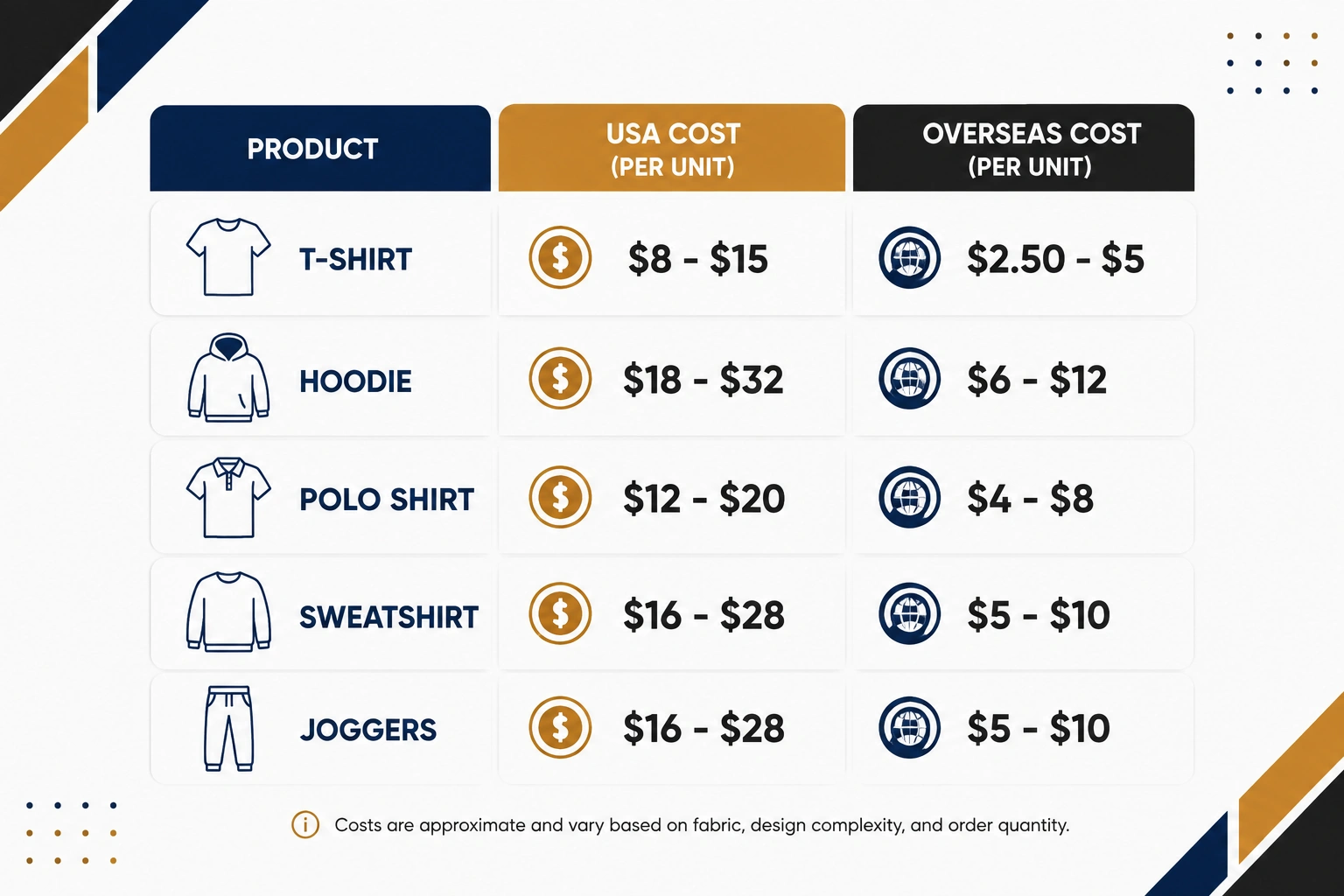
Here’s a fast comparison of average per unit manufacturing costs for popular garment types, based on mid weight fabrics, standard construction, and typical MOQs (minimum order quantities).
Product | USA Cost (per unit) | Overseas Cost (per unit) |
T-Shirt | $8 to $15 | $2.50 to $5 |
Hoodie | $18 to $32 | $6 to $12 |
Polo Shirt | $12 to $20 | $4 to $8 |
Joggers | $16 to $28 | $5 to $10 |
Jacket | $28 to $55+ | $10 to $22 |
These ranges reflect base manufacturing cost only. They don’t include design, sampling, freight, duties, or your own margin. We’ll walk through those below.
Remember, time is a crucial factor when it comes to quotations. You should ask for quotations to get the best rates, and they might differ the next time you come back. Though it is not that frequent, but an important information to look out for.
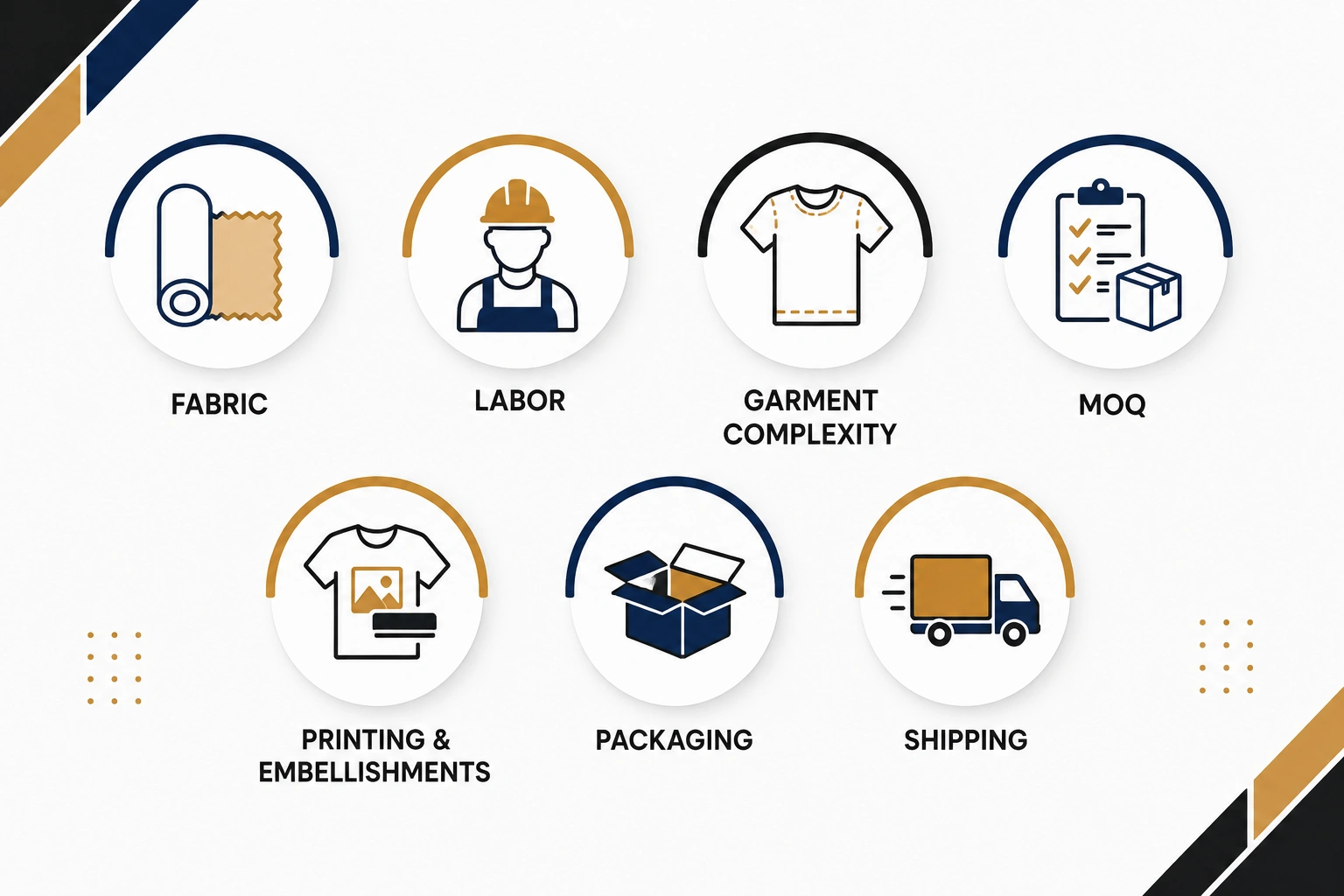
What Affects Apparel Manufacturing Cost?
Once you get a hold of these variables, you begin to assess the quotation more critically, hence making more sense of the numbers given to you.
- Fabric → Usually the largest cost component, influenced by fibre type, fabric weight (GSM), and finishing treatments.
- Labor → Manufacturing wages vary by country, making labor one of the biggest factors in production cost.
- Garment Complexity → More pattern pieces, seams, closures, and construction steps increase sewing time and cost.
- MOQ (Minimum Order Quantity) → Larger orders reduce the per-unit cost by spreading setup and production expenses across more garments.
- Printing & Embellishments → Screen printing, embroidery, DTG, and other decorations add cost based on size, colors, and placement.
- Packaging → Polybags, hang tags, labels, inserts, and branded packaging contribute to the final per-unit cost.
- Shipping → Freight and logistics costs depend on origin, shipping method, destination, and order volume.
Small runs almost always cost more per piece, and if you’re only ordering a handful of samples or a single garment, it’s worth understanding what it actually costs to manufacture one piece of clothing before you commit to a bigger run.
Breaking Down Apparel Manufacturing Cost in 2026
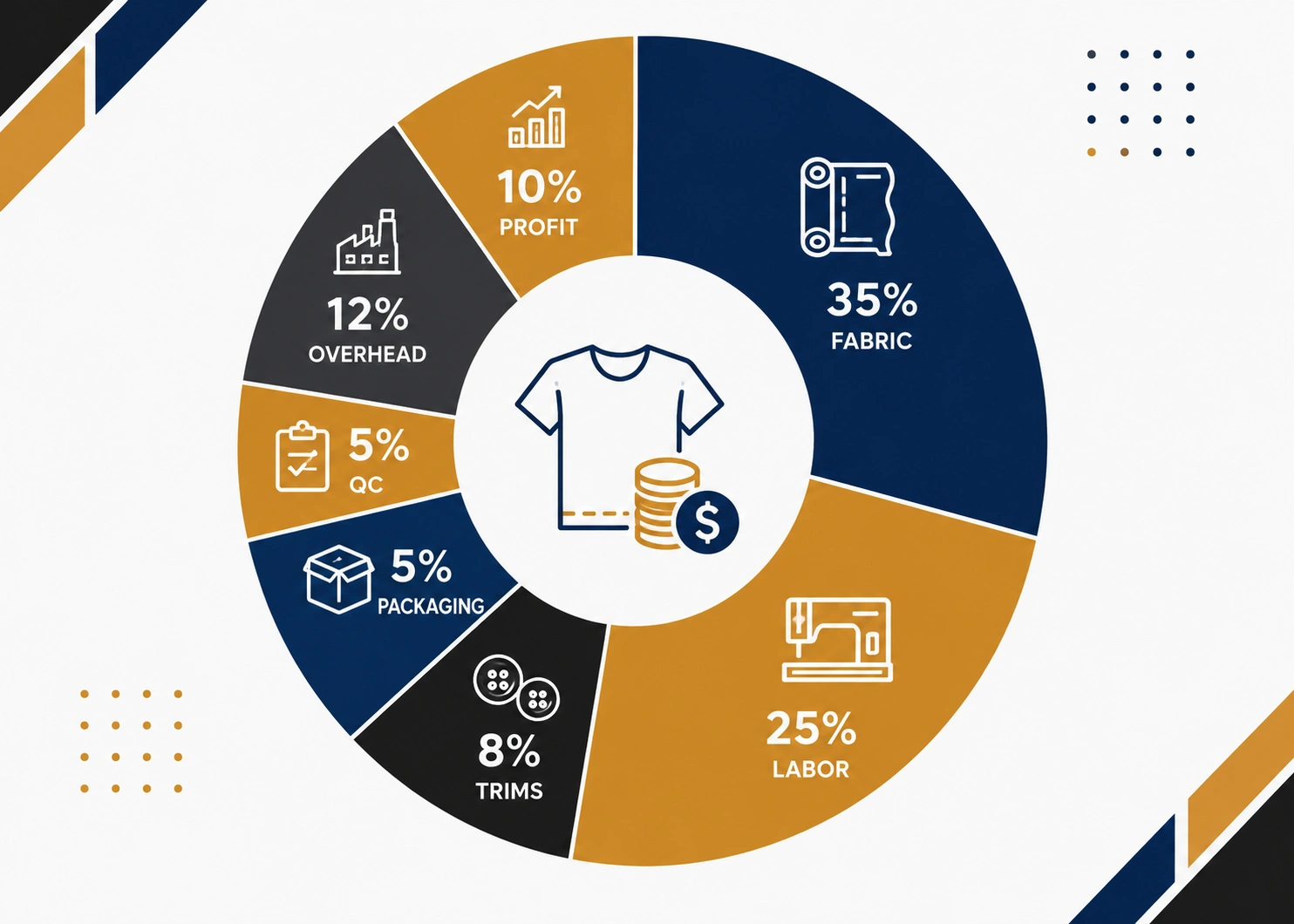
Fabric typically makes up 30 to 50% of the cost. It’s priced per yard or per kilogram depending on the factory and fabric type. A basic 100% cotton jersey might run $4 to $6 a yard, while performance blends or speciality knits can run $6 to $12 a yard.
Labor, or CM cost, usually runs 20 to 35%. This is what you pay the factory to cut, sew, and finish the garment, and it scales with construction complexity and the labor rate at that facility.
Trims make up around 5 to 10%. Zippers, buttons, drawcords, elastic, labels, and thread are individually cheap but add up fast on complex garments.
Packaging usually lands around 3 to 8%, covering polybags, tags, barcodes, and any custom packaging materials.
Quality control is typically 3 to 5%, covering in line inspections, final random inspection (AQL based), and any third party QC fees.
Factory overhead, meaning rent, utilities, equipment depreciation, and admin costs baked into the factory’s pricing, generally sits around 10 to 15%.
Profit margin for the factory usually runs 10 to 20%. This is standard and expected. A factory working at zero margin isn’t a stable long term partner.
A simple formula to work apparel manufacturing costs:
Manufacturing Cost per Unit = Fabric Cost + Trim Cost + Labor (CM) Cost + Packaging Cost + QC Cost + (Factory Overhead % + Margin %)
A roughly worked example, basic cotton t-shirt, overseas production:
Component | Cost |
Fabric (0.9 yd at $4/yd) | $3.60 |
Trims (labels, thread) | $0.20 |
Labor / CM | $0.90 |
Packaging | $0.15 |
QC | $0.10 |
Overhead plus margin (about 20%) | $1.00 |
Total manufacturing cost | About $5.95 |
That $5.95 is the FOB factory cost, before freight, duties, and your own margin get added.

Apparel Manufacturing Cost by Product
Here are estimated per unit manufacturing costs for the garment categories with the highest production demand.
- T-shirts typically cost $2.50 to $5 overseas and $8 to $15 domestically. Fabric weight (140gsm versus 220gsm) and print complexity are the biggest swing factors.
- Hoodies run $6 to $12 overseas and $18 to $32 in the USA. Heavier fleece, drawcords, kangaroo pockets, and ribbing all add cost compared to a basic tee.
- Polo shirts cost $4 to $8 overseas and $12 to $20 domestically. Pique knit fabric, collars, and plackets push cost above a standard T-shirt.
- Sweatshirts land close to hoodies but slightly lower without a hood, roughly $5 to $10 overseas and $16 to $28 in the USA.
- Joggers cost $5 to $10 overseas and $16 to $28 domestically. Elastic waistbands, cuffs, and pocket construction add labor time compared to a simple pant.
Across all five categories, fabric weight and embellishment are the two levers that move price the most.
Hidden Clothing Production Costs Most Brands Miss
There are a few technical aspects which are usually ignored or are within the hidden costs. Here’s what you must have some basic knowledge of too:
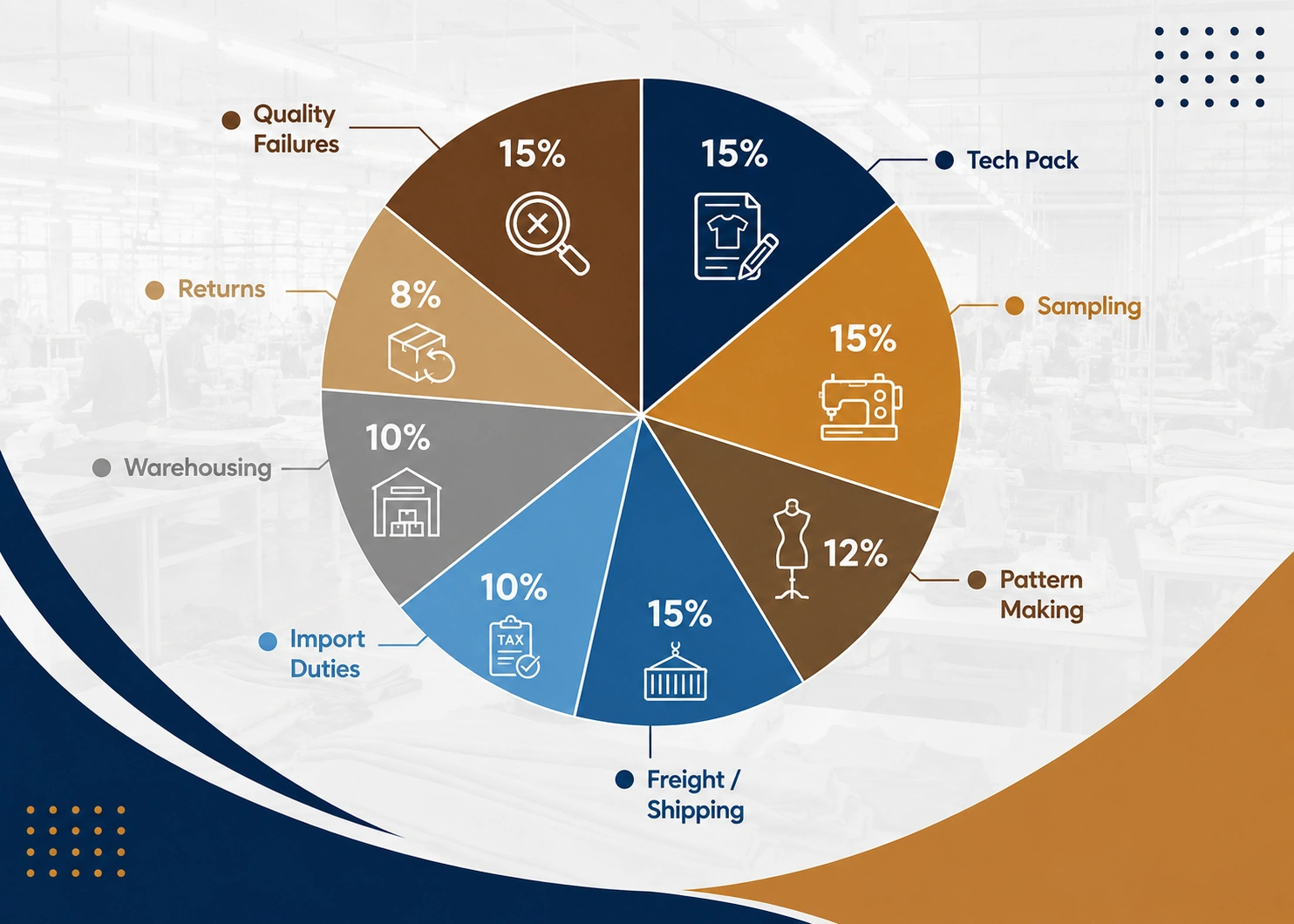
Tech packs. A professional tech pack (spec sheet, measurements, construction notes) typically costs $50 to $300 per style if outsourced. Factories often quote poorly, or won’t quote at all, without one.
Sampling. Expect $50 to $200 per sample round, and most styles need two to four rounds before approval. This is a real cost that a lot of first timers forget to plan for.
Pattern making. A custom pattern from scratch runs roughly $100 to $400 per style, on top of sampling.
Freight. Sea freight is cheap per unit but slow, usually four to eight weeks. Air freight is fast but can cost three to five times more per kilogram.
Import duties. US duty rates on apparel typically range from 8 to 32% depending on fabric content and garment category, a cost that catches a lot of founders off guard when the invoice arrives.
Warehousing. Storage and fulfillment fees add up month after month and are easy to underestimate on a first order.
Returns. Apparel return rates for online sales often run 15 to 30%, and each return has a real cost in processing, restocking, or write off.
Quality failures. Even a well vetted factory occasionally ships defects. Budgeting a small buffer, around 2 to 5% of units, for QC losses is realistic, not overly cautious.
How to Reduce Apparel Manufacturing Cost and Maximize Profits
Lowering apparel manufacturing cost is about improving production efficiency, reducing waste, and making smarter sourcing decisions. These practical ways reduce your per-unit cost without compromising quality, eventually maximizing profit margins.
- Create Detailed Tech Packs
Provide clear specifications, measurements, construction details, and artwork to minimize production errors, reduce sampling rounds, and avoid costly revisions.
- Increase Your Order Quantity
Produce larger quantities when demand justifies it. Higher order volumes spread setup, sampling, and production costs across more units, reducing the cost per garment.
- Minimize Fabric Variations
Use the same fabric across multiple styles whenever possible. Consolidating fabric purchases helps meet supplier minimums and often results in better pricing.
- Standardize Trims and Components
Reuse trims such as labels, zippers, buttons, and drawcords across your collection to simplify sourcing, reduce minimum order requirements, and lower material costs.
- Work With the Right Manufacturing Partner
Choose a factory that specializes in your garment category and production volume. An experienced manufacturer can improve efficiency, reduce mistakes, and provide more accurate pricing.
- Consolidate Shipments
Combine multiple styles or production runs into fewer shipments whenever possible. This lowers freight costs per unit and improves overall logistics efficiency.
Get a Real Cost Estimate for Your Apparel Line
Every range in this guide is a starting point, not the number you’ll actually pay. Fabric choice, construction, order size, and your finished tech pack all shape the final quote for your specific style.
Manufacturing costs vary by factory, order timing, and market conditions, so treat the figures above as planning estimates. If you’re ready to move past estimates and get a real number, the Innovate Apparel team can walk through your design, recommend a production path, and give a quote based on your targets.
We are here to help you figure out what it really costs to bring your apparel to life.
Reach Out To Us: 👉 Innovate Apparel Contact