

Private Label Clothing Cost Per Unit: A Transparent Breakdown
Private label clothing cost per unit can vary widely because manufacturers price the actual garment you want to produce, not simply the clothing category.
A basic T-shirt with a simple label and one decoration location has a very different cost structure from a heavyweight hoodie with custom fabric, embroidery, woven labels, and packaging.
Quantity changes the equation too. Sampling, development, setup, and other fixed costs can have a much larger effect on a small production run than on a larger order.
That is why one private label clothing manufacturer might quote a seemingly low unit price while another gives you a much higher figure for the same product.
The difference often comes down to what each quote includes.
This guide by Innovate Apparel breaks down private label clothing costs per unit by multiple production variables. You’ll also learn how to calculate the cost that actually matters to your business: your landed cost per sellable garment.
A Quick Summary of Private Label Clothing Cost Per Unit
For each type of apparel, the private label clothing cost can vary due to numerous factors. We’ve compiled a short table to help you get an idea of which factors to look out for.
Garment Type | Main Cost Drivers | Complexity |
Basic T-shirt | Fabric, GSM, construction, decoration, labels | Low to moderate |
Premium T-shirt | Fabric quality, GSM, fit, finishing, decoration | Moderate |
Polo | Fabric, collar, placket, buttons, construction | Moderate |
Hoodie | Fabric weight, fleece, hood, trims, construction | Moderate to high |
Sweatshirt | Fabric, GSM, construction, finishing | Moderate |
Joggers | Fabric, waistband, pockets, trims, construction | Moderate to high |
Jacket | Outer fabric, lining, hardware, panels, construction | High |
Fashion top | Fabric, pattern, trims, fit, construction | Moderate to high |
For an accurate private label clothing quote, finalize your private label clothing requirements and send them over to us via email or through the contact form.

What Is Included in Private Label Clothing Cost Per Unit?
When a clothing manufacturer quotes $X per unit, that number rarely represents the cost of fabric and sewing alone. Your final price can also reflect the garment’s construction, trims, labeling, printing or embroidery, packaging, quality-control requirements, and the order quantity you commit to.
A $10 T-shirt from one supplier may not be equivalent to a $10 T-shirt from another if one quote includes custom labels, branded packaging, and finishing while the other covers only cut-and-sew production.
Here’s what is included in private label clothing cost per unit:
Fabric and Materials
Fabric usually forms a fundamental part of the garment cost because the material determines much of the product’s physical specification. Fiber composition, fabric weight, construction, quality, color, and sourcing requirements can all affect the amount you pay.
Cutting and Sewing
Cutting and sewing transform the fabric into the finished garment. A simple T-shirt requires fewer operations than a structured jacket with multiple panels, pockets, lining, and hardware.
Trims and Components
Trims add both material and production costs. Depending on the garment, these may include buttons, zippers, elastic, drawcords, patches, hardware, and other components.
Labels and Branding
Private label products commonly include brand-specific labels and other identity elements. These can include woven labels, printed neck labels, care labels, hangtags, patches, and branded packaging.
Decoration
Printing and embroidery add another layer of production work. The decoration method, artwork, dimensions, colors, stitch count, number of locations, and garment compatibility can influence the cost.
Quality Control
Quality control requires inspection and production checks. The exact scope depends on the manufacturer’s process and the quality standards agreed for the order.
Finishing and Packaging
Finishing can include folding, pressing, labeling, tagging, individual packaging, and retail-ready preparation. These services become particularly important when you sell directly to consumers or wholesale buyers.
Private Label Pricing Breakdown: Every Cost Component Explained
A manufacturer’s private label pricing breakdown should tell you more than the final per-unit figure. The quote should make clear which materials, production steps, branding elements, and order requirements are driving the price.
For budgeting purposes, a basic private label garment can often fall around $5–$15 per unit, while premium fabrics, complex construction, extensive decoration, and custom packaging can push the cost well above that range. Your actual price depends heavily on the garment type, order quantity, specifications, and production location.
Here are the main cost components to look at.
Fabric Cost
Fabric is usually one of the biggest variables in apparel costing. The fiber alone does not determine the price.
Manufacturers may price the fabric based on:
- Fiber composition and quality
- GSM and fabric weight
- Knit or woven construction
- Yarn quality
- Finishing and treatments
- Custom dyeing or color matching
- Minimum fabric quantities
For example, a standard cotton T-shirt fabric may cost considerably less than a heavyweight cotton, specialty blend, or custom-finished fabric.
Typical impact: Fabric can account for roughly 25% to 50% of a basic garment’s manufacturing cost, depending on the product and material.
Garment Construction and Labor
The factory has to cut, sew, assemble, finish, and inspect every garment. More operations generally mean a higher unit cost.
A simple T-shirt with a few panels requires far fewer operations than a jacket with multiple panels, pockets, zippers, lining, cuffs, and structured construction.
Construction costs can increase with:
- Number of panels and seams
- Pattern complexity
- Pockets and specialized details
- Collars, cuffs, and waistbands
- Multiple construction stages
- Additional finishing and inspection
Typical impact: Labor and construction may represent roughly 20% to 40% of the manufacturing cost, although the proportion varies significantly by garment type and production location.
Trims and Components
Small components can add up quickly when a garment uses several of them. Depending on the design, your quote may include zippers, buttons, snaps, elastic, drawcords, patches, buckles, or other hardware.
A basic crew-neck T-shirt might need only a few trims. A hoodie, jacket, or fashion garment can require substantially more.
Typical impact: Allow roughly $0.20 to $2+ per unit for trims on many garments, with specialized hardware potentially costing more.
Printing and Embroidery
Custom decoration adds another layer to the manufacturing cost. The price depends on the technique, artwork, size, placement, number of locations, and order quantity.
For budgeting, common decoration costs may fall roughly within these ranges:
Decoration | Rough cost per unit |
Screen printing | $0.50–$3+ |
DTF printing | $0.50–$3+ |
DTG printing | $2–$5+ |
Basic embroidery | $1–$4+ |
Large/dense embroidery | $3–$8+ |
These figures are only starting points. A large multi-color print or dense embroidery design can cost substantially more than a small chest logo.
You can also read:
Labels, Tags, and Packaging
Private labeling also adds the brand-specific elements that distinguish your garment from a blank wholesale product.
These can include woven labels, care labels, hangtags, size labels, patches, polybags, boxes, and custom retail packaging.
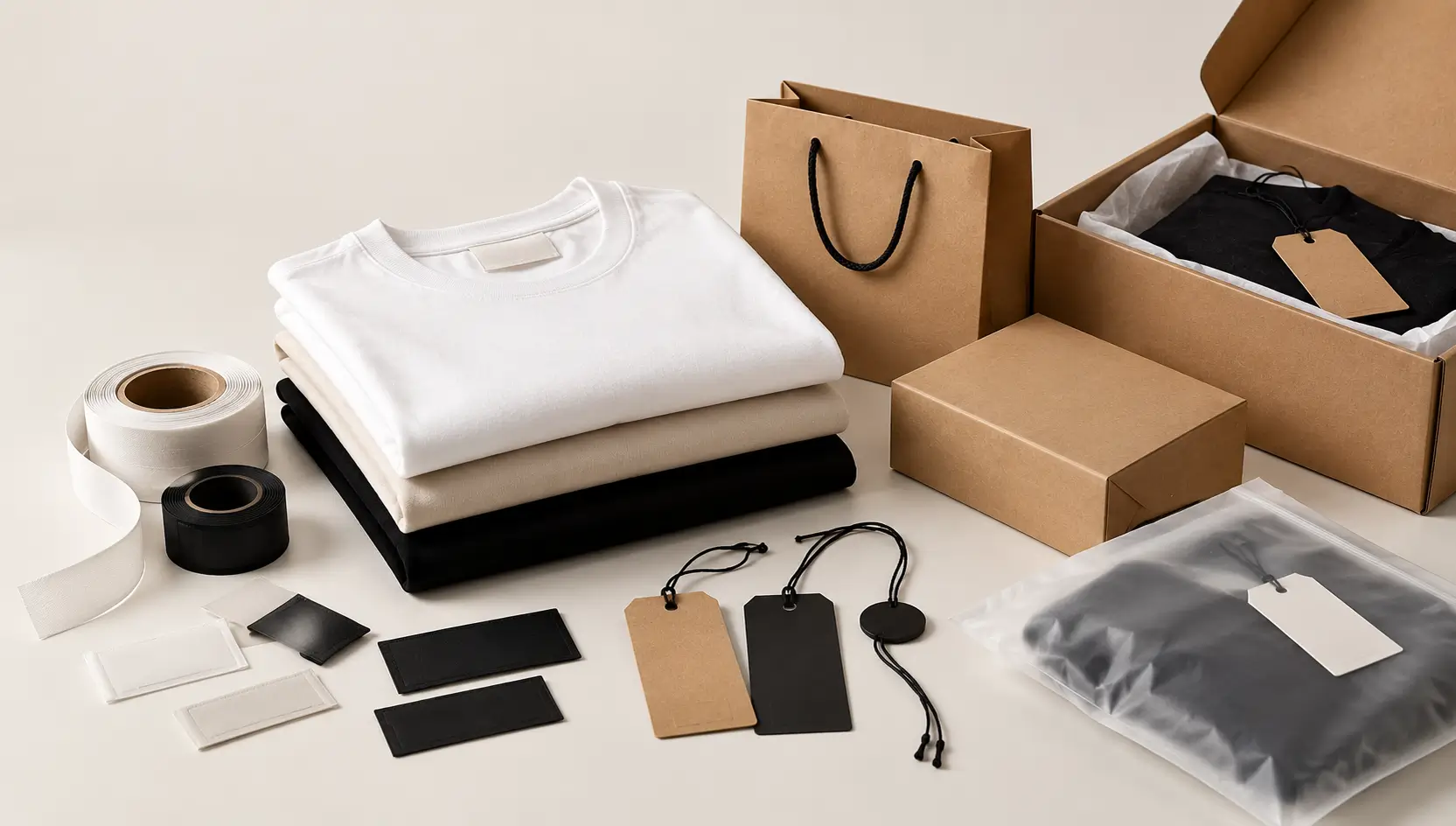
For basic branding and packaging, you might budget approximately $0.20 to $2+ per unit, depending on how extensively you customize the presentation.
Also separate one-time setup costs from recurring unit costs. Pattern development, sampling, embroidery digitization, print setup, and certain packaging preparations may occur before bulk production rather than appearing as a recurring cost on every garment.
What Does a Private Label Garment Actually Cost?
As a rough planning guide:
- Basic T-shirt: $5–$10+/unit
- Premium or heavyweight T-shirt: $8–$15+/unit
- Hoodie or sweatshirt: $10–$20+/unit
- Custom jacket or complex garment: $15–$35+/unit
- Highly customized or premium apparel: $25+/unit
You should contact Innovate Apparel to get the best quotation for your private label needs.
These are indicative budgeting ranges, not fixed manufacturer prices. A 500-piece order with premium fabric and extensive customization can have a very different unit cost from a 5,000-piece order using a standard fabric and simpler construction.
For an accurate private label clothing cost per unit, provide the manufacturer with your garment type, fabric specification, GSM, size range, quantity, colors, artwork, branding requirements, packaging preferences, and delivery destination.
For a production-specific quote, contact Innovate Apparel with your requirements. Their team can assess your specifications and provide a quotation based on the actual garment you want to manufacture rather than relying on generic industry averages.

How Order Quantity Changes Private Label Cost Per Unit
Order quantity can change the economics of private label production because fixed or setup-related expenses get distributed across the garments in the order.
The same development expense can have a very different effect on a 50-unit production run and a 1,000-unit production run.
50 to 100 Units
Smaller production runs typically give fixed costs a larger influence on the unit price because fewer garments absorb those expenses.
A smaller run may involve:
- Higher fixed-cost contribution per garment
- Lower purchasing leverage
- Sampling and development expenses
- Smaller production efficiencies
- Higher setup impact
- Greater unit-cost sensitivity
This production range can work well for testing a product concept or validating demand before committing to larger inventory.


300 to 500 Units
A mid-volume order can provide more room for production efficiency while keeping inventory at a manageable level for many growing brands.
At this stage, manufacturers may achieve improved economics through:
- Larger material purchases
- More efficient production scheduling
- Better allocation of setup costs
- Longer production runs
- Greater sourcing leverage
The exact effect depends on the garment and manufacturer’s production structure.
1,000+ Units
Larger orders can create stronger volume economics because production, sourcing, and preparation can operate at a larger scale.
Higher volumes may support:
- Larger fabric purchases
- More efficient production planning
- Better use of manufacturing capacity
- Lower fixed-cost contribution per unit
- More predictable production scheduling
Larger orders also create greater inventory exposure.
A lower unit price has limited value if your business cannot sell the additional stock.

Why Larger Orders Usually Have a Lower Cost Per Unit
The relationship between quantity and unit cost becomes easier to understand when you separate fixed costs from variable production costs.
A simplified formula is:
Unit Cost = Variable Production Cost + (Fixed Costs ÷ Quantity)
Consider a hypothetical $1,000 setup cost.
At 50 units:
$1,000 ÷ 50 = $20 per unit
At 100 units:
$1,000 ÷ 100 = $10 per unit
At 500 units:
$1,000 ÷ 500 = $2 per unit
At 1,000 units:
$1,000 ÷ 1,000 = $1 per unit
This calculation illustrates the mechanism. It does not represent a standard private label manufacturing price or a typical setup fee.
Your actual unit cost also includes the variable production costs associated with the garment.
How Fabric, GSM, and Garment Construction Affect Private Label Clothing Cost
Fabric, GSM, and garment construction directly influence private label clothing cost per unit. The right combination depends on the garment type, intended use, target quality, and production quantity.
GSM measures fabric weight, while construction determines how much work goes into turning that fabric into a finished garment. Both factors should appear in your private label pricing breakdown.
How GSM Affects Private Label Clothing Cost
GSM can affect material usage, garment weight, hand feel, and production requirements. A higher GSM can increase fabric cost, but a heavier garment does not automatically deliver better value.
Consider:
- Garment category
- Fabric composition
- Intended use
- Climate
- Fit
- Brand positioning
- Hand feel
- Durability requirements
For example, a lightweight T-shirt of 180 GSM may suit warm-weather apparel, while heavyweight fabric of 240 GSM may support premium T-shirts, hoodies, and streetwear.
How Garment Construction Affects Unit Cost
Garment construction determines the number and complexity of manufacturing operations required to produce each piece. More panels, seams, pockets, trims, and finishing steps can increase clothing manufacturing cost per unit.
A basic T-shirt generally requires fewer operations than a jacket with lining, hardware, pockets, and multiple panels.
Key cost drivers include:
- Pattern complexity
- Number of panels
- Seam construction
- Pockets
- Collars and cuffs
- Waistbands
- Linings
- Hardware
- Finishing requirements
When comparing private label manufacturers, evaluate construction alongside fabric and GSM to understand the actual unit cost.
Private Label Clothing Cost by Garment Type
Private label clothing does not have one standard cost per unit. T-shirts, hoodies, polos, joggers, jackets, and fashion tops require different materials and manufacturing operations, so each garment needs its own private label pricing breakdown.
T-Shirt Cost Per Unit
T-shirt manufacturing cost depends mainly on fabric, GSM, fit, construction, decoration, branding, and order quantity.
Cost factors: Fabric → GSM → fit → construction → labels → decoration → quantity.
A basic lightweight T-shirt can have a different unit cost from a heavyweight premium T-shirt with custom branding and embroidery.
Hoodie Cost Per Unit
Hoodie cost typically reflects fabric weight, fleece construction, hood assembly, pockets, ribbing, drawcords, decoration, and branding.
Cost factors: Fabric → GSM → hood → pockets → ribbing → drawcords → decoration → labels → quantity.
Sweatshirt Cost Per Unit
Sweatshirt pricing depends on fabric, GSM, fleece construction, ribbing, fit, finishing, decoration, and quantity.
Cost factors: Fabric → GSM → construction → ribbing → finishing → branding → quantity.
Polo Cost Per Unit
Polo manufacturing involves additional components such as collars, plackets, buttons, and related finishing.
Cost factors: Fabric → GSM → collar → placket → buttons → construction → branding → quantity.
Jogger Cost Per Unit
Jogger pricing depends on fabric, waistband construction, pockets, cuffs, drawcords, panels, and finishing.
Cost factors: Fabric → waistband → pockets → cuffs → drawcords → construction → branding → quantity.
Jacket Cost Per Unit
Jackets typically require more complex construction than basic knitwear. Lining, multiple panels, zippers, pockets, hardware, and specialized finishing can increase private label apparel manufacturing cost.
Cost factors: Outer fabric → lining → panels → hardware → pockets → closures → construction → finishing.
Fashion Top Cost Per Unit
Fashion tops can vary widely because silhouettes and construction methods differ across styles.
Cost factors: Fabric → pattern → fit → panels → seams → trims → finishing → branding → quantity.
When comparing private label clothing cost per unit, always compare the complete garment specification. Fabric, GSM, construction, branding, decoration, quantity, and logistics can all change the final price.

First Production Run vs Reorder: Why Unit Cost Can Change
Your first production run can include development and setup expenses that may not repeat at the same level during subsequent production.
That makes reorder economics especially important for private label brands.
First Production Run
The first run may include:
- Sampling
- Setup
- Label development
- Pattern adjustments
- Artwork preparation
- Product corrections
These costs can raise the effective first-run unit cost.
Repeat Production
A reorder may reuse established specifications, approved patterns, labels, artwork, and production processes.
Some development expenses may therefore disappear or decrease.
That means your first-run unit cost does not necessarily represent your long-term production cost.
A brand planning repeat orders should discuss reorder pricing with the manufacturer before committing to the first production run.
Compare the Cost Structure, Not Just the Unit Price
Private label clothing cost per unit starts with the product specification.
Fabric determines material requirements. GSM affects garment weight and material usage. Construction determines production operations. Branding adds labels and identity elements. Decoration creates another layer of production. Quantity changes how fixed costs affect each garment. Logistics determines what the product ultimately costs to receive.
That creates a simple principle for comparing manufacturers:
Do not compare private label clothing by unit price alone. Compare the complete cost structure behind the unit price.
For Innovate Apparel, this manufacturing first approach also gives brands a clearer path from product concept to production. You can define the garment you want, identify the major cost drivers, and then work with your manufacturer to optimize the specification around your target economics.
Planning a private label clothing collection?
Reach out to Innovate Apparel today – A 10% off discount campaign is live!