Choosing a printing method can change how an apparel product looks, feels, performs, and costs to produce.
Screen printing and direct to garment (DTG) printing can both produce high-quality apparel, yet they handle artwork, fabrics, production volumes, colors, and production workflows differently.
A detailed graphic that works beautifully with DTG may require a different production approach when the same design moves into a high-volume collection.
The right decision depends on several factors, such as artwork complexity, print size and placement, durability requirements, budget and more.
This guide explains screen printing vs DTG from an apparel manufacturing perspective so you can evaluate the printing process against the actual requirements of your clothing line.
Screen Printing vs DTG: Quick Comparison
The table provides a starting point. Your garment, artwork, production quantity and printer’s workflow can change the practical choice.
Factor | Screen Printing | DTG Printing |
Setup | Requires screen preparation and artwork separation | Requires digital artwork preparation and machine setup |
Best artwork | Bold graphics, typography, illustrations and designs suited to color separation | Detailed artwork, gradients, photographs and complex graphics |
Color handling | Uses separate ink colors and screens | Uses digital ink application |
Small runs | Setup can make small runs less economical | Well suited to short runs |
Repeated production | Highly suitable for repeated designs | Suitable when equipment and workflow support the required volume |
Hand feel | Depends on ink, coverage and application | Often soft on suitable garments and properly processed prints |
Fabric compatibility | Broad, with appropriate ink and process selection | Depends more heavily on garment, fabric and ink system |
Personalization | Requires additional production considerations | Well suited to variable digital artwork |
Repeatability | Strong once artwork and screens receive approval | Strong with a controlled digital workflow |
Cost structure | Setup, screens, inks, garment, labor and quantity influence cost | Garment, ink, pretreatment, machine time, curing and labor influence cost |
Production model | Often efficient for repeated batch production | Well suited to short runs and variable production |
Specialty effects | Strong range of specialty inks and effects | More dependent on the specific digital system |
What Is Screen Printing?
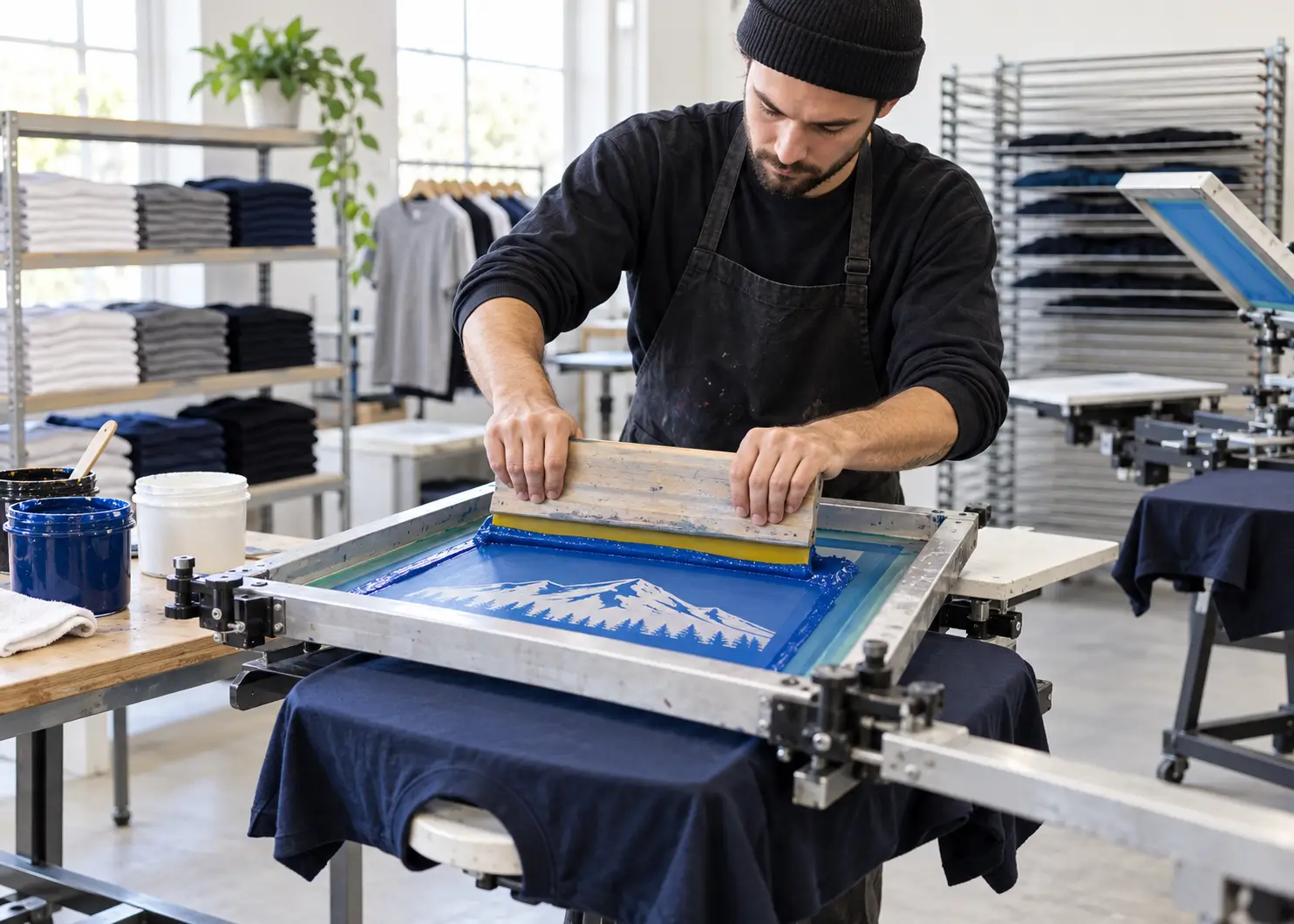
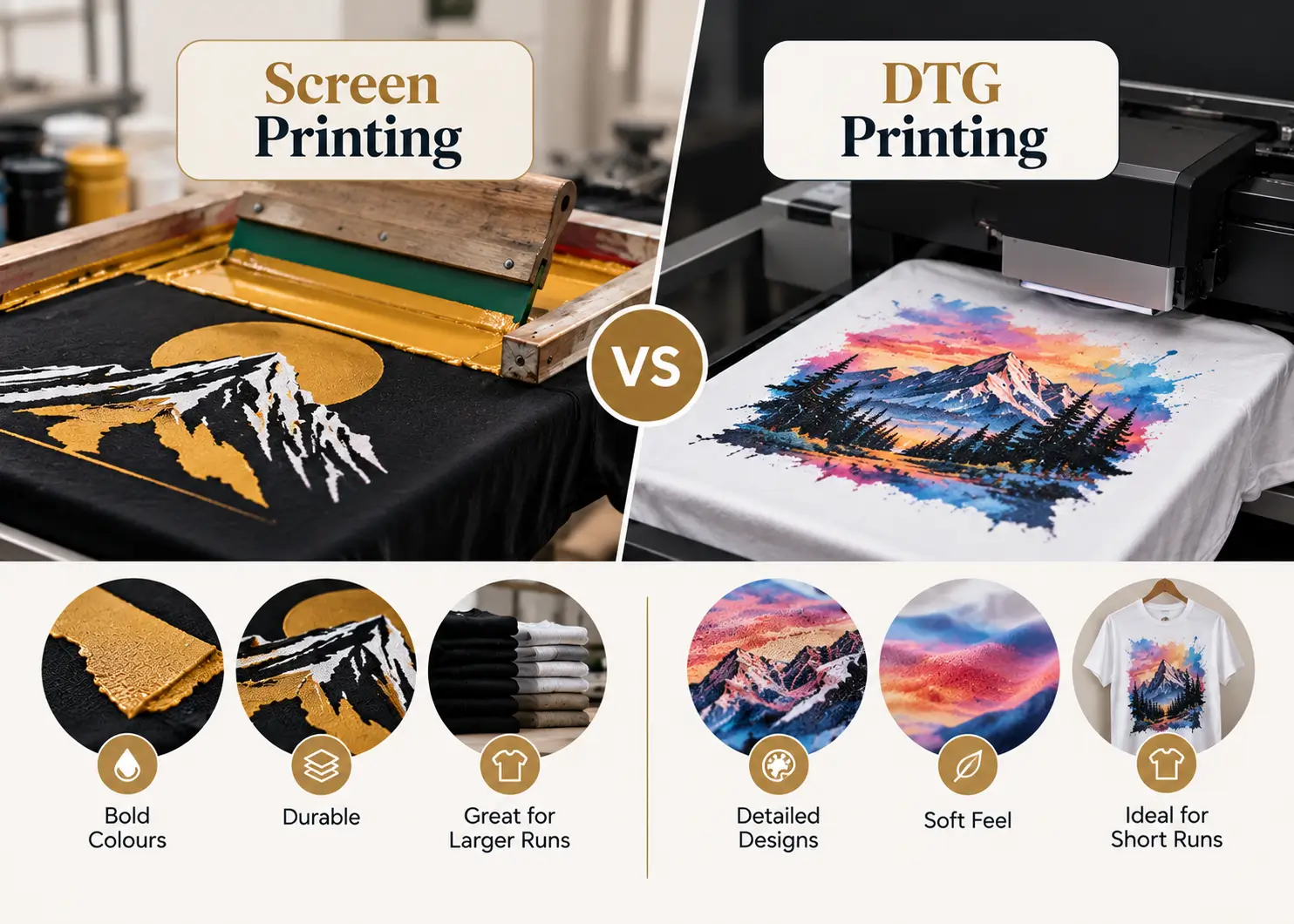
Screen printing applies ink to a garment through a prepared mesh screen.
The production team prepares the artwork, separates the colors when required, creates the screens, positions the garment, applies ink through the screens and cures the finished print.
Each color can require its own screen and production setup. This makes artwork preparation and registration important parts of the process.
Screen printing has remained widely used in apparel production because it can produce strong colors, repeatable graphics and specialty finishes across many garment types when the production team selects the appropriate ink and process.
How Does Screen Printing Work?
A typical screen printing workflow includes these steps:
- Prepare the artwork. The printer checks dimensions, colors, print placement and other production specifications.
- Separate the artwork. Multi-color artwork may require color separations for individual screens.
- Prepare the screens. The production team transfers the artwork to the appropriate screens.
- Prepare the garment. The garment receives positioning and production checks before printing.
- Apply the ink. The printer pushes ink through the screen onto the garment.
- Repeat for additional colors. Each required color receives the appropriate production pass.
- Cure the print. The printer cures the ink according to the requirements of the selected ink system.
- Inspect the garment. Quality control checks placement, color, coverage, registration and overall appearance.
The exact workflow varies by printer, equipment, ink system and garment.
Advantages of Screen Printing
Screen printing offers several advantages for apparel brands.
- Produces bold, highly opaque graphics, including on darker garments.
- Works well for repeated production once artwork, screens, and settings receive approval.
- Supports specialty finishes such as metallic, puff, and high-density effects.
- Works across a broad range of garments and materials with the appropriate ink system.
- Can offer better batch-production economics because setup costs spread across larger quantities.
Limitations of Screen Printing
Screen printing also creates production considerations.
- Requires setup time for screens, artwork separation, registration, and machine preparation.
- Complex artwork may require more detailed color separations and production preparation.
- Setup costs can make small orders less economical.
- Frequent design changes can require repeated setup and preparation.
- Multi-color designs require accurate registration to maintain a clean finished appearance.
What Is DTG Printing?
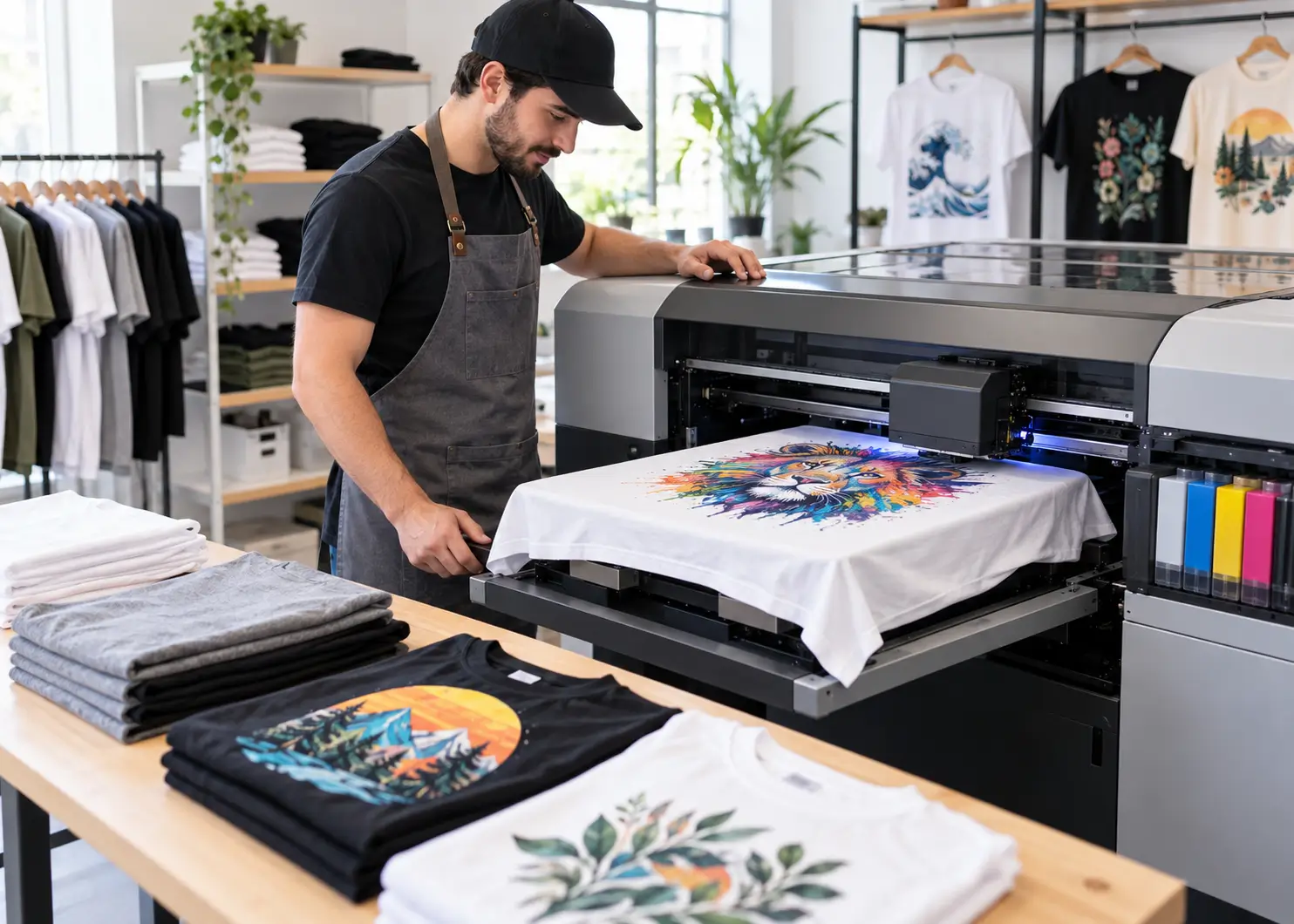
Direct to garment printing, commonly called DTG, applies specialized ink directly to a garment through digital printing technology.
The printer works from digital artwork and applies ink to the garment according to the selected print settings. Depending on the garment, ink system and equipment, pretreatment may form part of the process.
DTG works particularly well with detailed artwork, gradients, photographic images and designs containing many colors.
Modern digital textile printing also extends beyond the small-run assumptions often associated with basic DTG workflows. Industrial digital systems can support larger production environments, depending on the equipment, garment requirements and production setup.
How Does DTG Printing Work?
A typical DTG workflow includes:
- Prepare the artwork. The artwork receives appropriate sizing, resolution and color preparation.
- Prepare the garment. The production team checks the garment and positions it for printing.
- Apply pretreatment when required. The selected garment and ink system determine the pretreatment requirements.
- Load the garment. The operator positions the garment on the printing system.
- Print the artwork. The machine digitally applies the required inks.
- Cure the print. The production team cures the ink according to the ink and equipment specifications.
- Inspect the garment. Quality control checks color, placement, detail, coverage and overall finish.
The exact workflow depends on the digital printing system and garment.
Advantages of DTG Printing
- Handles fine details, gradients, photographic imagery, and complex color transitions well.
- Requires minimal physical setup compared with traditional screen printing.
- Works well for short production runs without creating separate screens for each artwork color.
- Supports personalized and variable designs across individual garments.
- Allows brands to test artwork and product concepts before committing to larger quantities.
- Supports on-demand production based on incoming orders.
Disadvantages of DTG
- Fabric composition, surface, and garment color can affect the final print result.
- Some DTG workflows require pretreatment, especially for certain dark garments.
- Ink consumption, machine time, maintenance, and curing can increase production costs.
- Production speed varies based on equipment, print size, garment type, and workflow.
- The same artwork can produce different visual results across fabrics, garment colors, and constructions.
Key Differences Between Screen Printing vs. DTG
The most useful comparison goes beyond the basic question of which method handles more garments. It comprises of several factors which are discussed individually below:
Design Complexity
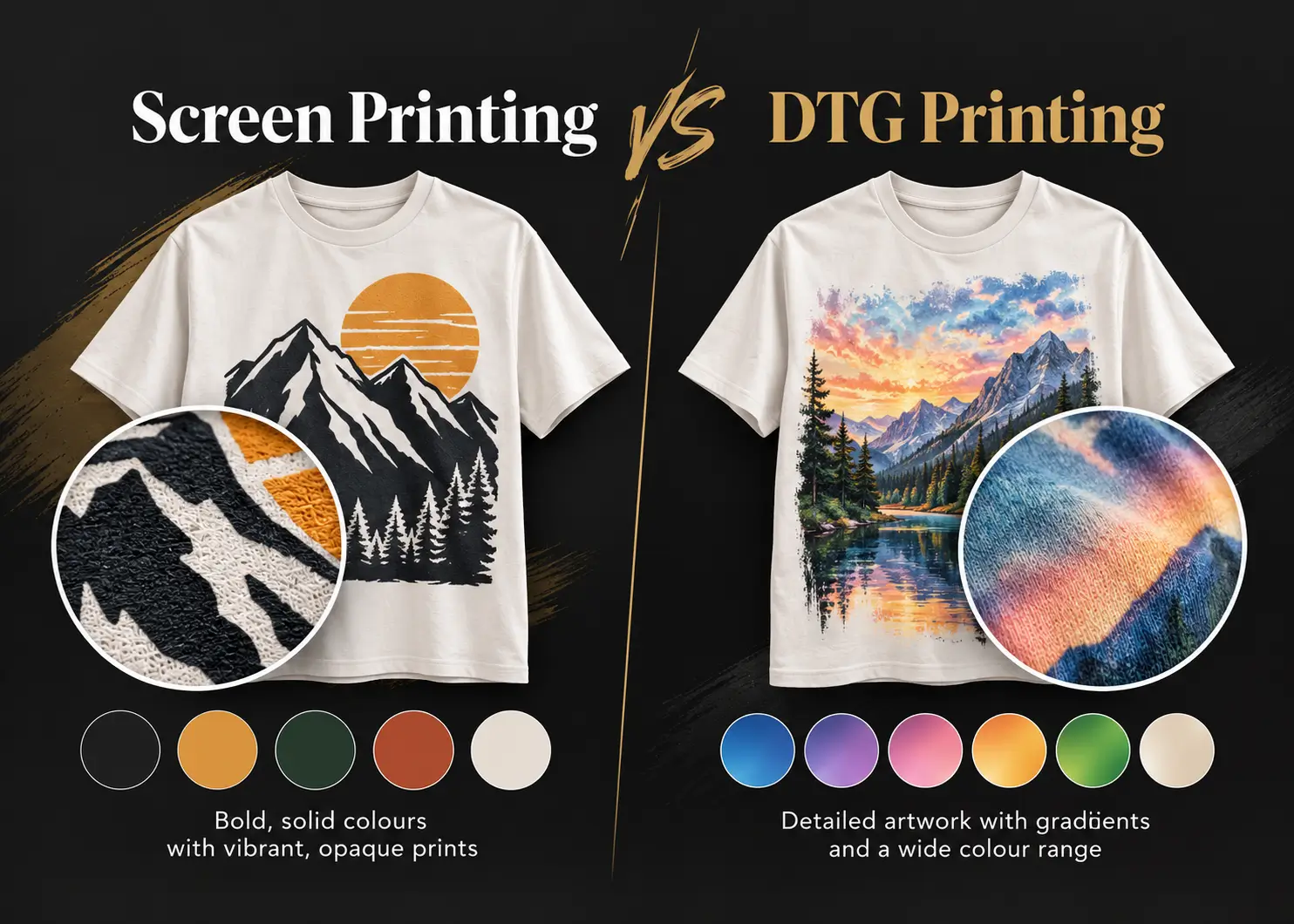
DTG handles complex digital artwork particularly well.
Photographs, gradients, detailed illustrations and designs with many color transitions can move directly from digital artwork into the printing workflow.
Screen printing works especially well with bold graphics, typography, illustrations and artwork that translates effectively into separated ink colors.
A design’s visual structure should guide the production decision.
Number of Colors
Screen printing handles colors through individual ink applications and artwork separations.
As the number of colors increases, the artwork preparation and production setup can become more involved.
DTG handles full-color digital artwork through its ink system. The printer translates the digital file into the required ink output.
This does not mean DTG carries a universal flat cost for every full-color design. Ink consumption, print area, garment, white ink requirements, pretreatment and equipment all influence the actual production cost.
Print Quality
Both methods can produce high-quality apparel when the printer uses the right equipment, garment and production settings.
DTG has a strong advantage for:
- Fine details
- Gradients
- Photographic artwork
- Complex color transitions
- Intricate illustrations
Screen printing has a strong advantage for:
- Bold graphics
- Strong solid colors
- Typography
- Simple illustrations
- Specialty ink effects
- High-opacity applications
The artwork itself should determine the quality criteria you prioritize.
Print Feel and Hand Feel
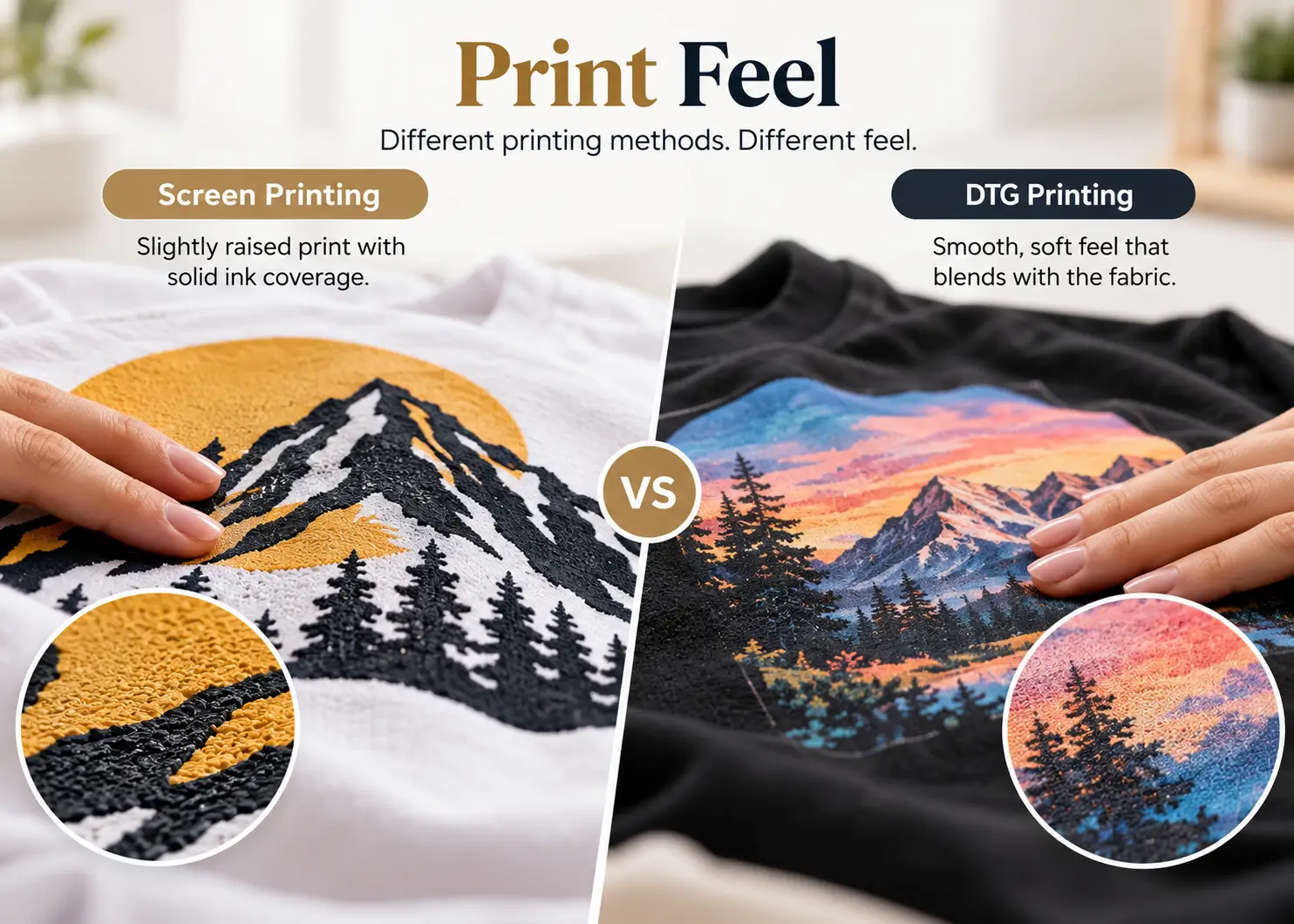
Hand feel describes how the printed area feels when you touch the garment.
Screen printing can create a more noticeable print surface depending on the ink, print coverage, ink deposit and production process.
DTG can provide a softer print feel on suitable garments because the digital ink interacts with the garment surface differently.
For premium apparel printing, contact Innovate Apparel, request a physical sample, and evaluate the print by touch.
Durability
Both screen printing and DTG can produce durable apparel prints.
Print durability depends on the complete production system.
Important factors include:
- Garment fabric
- Curing
- Print area
- Washing temperature
- Detergent
- Drying conditions
- Garment wear
The best way to assess durability is to test the actual garment, ink system, and production process you plan to use.
Fabric Compatibility
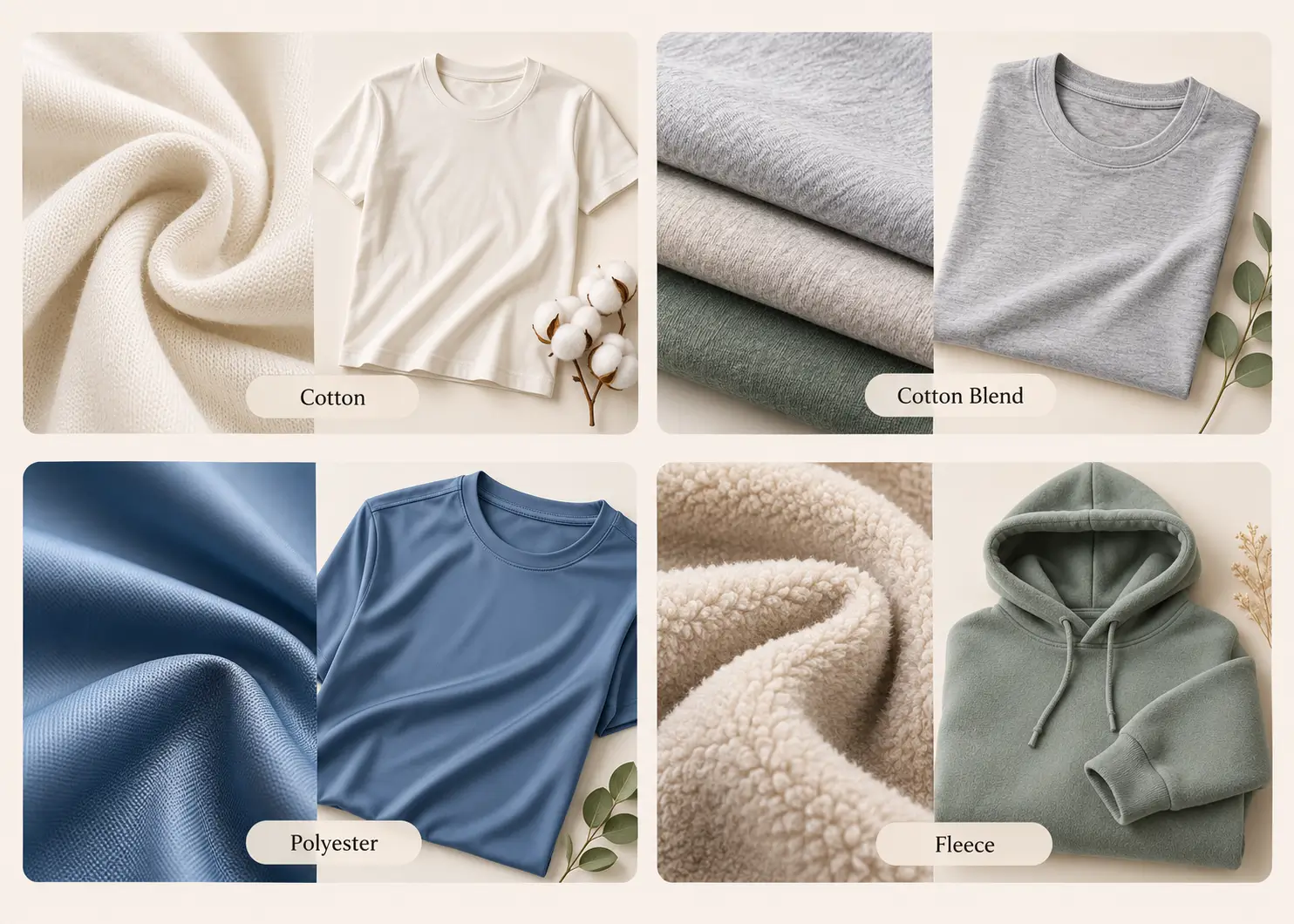
Fabric composition can influence the printing method and final appearance.
For instance, check our guide on denim vs. jeans to understand how these terms differ and how denim construction can affect apparel production decisions.
Cotton
Cotton works well with many apparel printing systems, including both screen printing and DTG, when the printer selects appropriate materials and settings.
Cotton Blends
Blended fabrics can require different production considerations because the fiber composition influences ink behavior and appearance.
Polyester
Polyester requires careful process selection. Dye migration and fabric-specific behavior can affect the print.
Fleece
Hoodies and sweatshirts often use fleece constructions with different surface characteristics from lightweight T-shirts. The print method, placement and print area should account for the garment surface.
Performance Fabrics
Synthetic performance garments can require specialized printing systems or processes. Always confirm compatibility with the printer before approving production.
You can also take a look at: Top 10 Fabric Choices for Premium Custom Hoodies
Production Quantity
Order quantity influences the economics of both methods.
Screen printing includes setup requirements, so producing repeated designs at larger quantities can spread those setup costs across more garments.
DTG can make shorter runs easier because digital artwork requires less physical setup.
There is no universal quantity where one method automatically becomes cheaper.
Compare actual quotes using the same:
- Garment
- Print size
- Print placement
- Artwork
- Number of units
- Color requirements
- Production specifications
This gives you a meaningful cost comparison.
Cost
A proper comparison should consider the complete production cost. The remaining cost factors, such as the garment, artwork preparation, ink, labor, etc., can apply to both screen printing and DTG. The exact cost will vary based on the garment, design requirements, order size, equipment, and production workflow.
Unique Screen Printing Costs
- Screens
- Color separations
- Setup
Unique DTG Costs
- Pretreatment
- Machine time
- Maintenance
Your supplier’s quote should reflect the complete production combination.
A lower advertised base price can become less competitive after you add setup, garment, shipping, finishing or other production costs.
Screen Printing vs DTG: Which Is Better for Your Design?
Use your actual product requirements to narrow the choice.
Your Requirement | Printing Method to Evaluate |
Photorealistic artwork | DTG |
Detailed illustrations | DTG |
Complex gradients | DTG |
Variable artwork | DTG |
Personalized garments | DTG |
Short production runs | DTG |
Bold one or two-color graphics | Screen printing |
Repeated designs at volume | Screen printing |
Specialty ink effects | Screen printing |
Strong solid-color graphics | Screen printing |
Established high-volume designs | Screen printing |
Frequent artwork changes | DTG |
These guidelines describe common applications. Your garment, printer, equipment and production quote can change the practical decision.
Is DTG More Sustainable Than Screen Printing?
DTG does not automatically produce a lower environmental impact.
A meaningful comparison should examine the complete production workflow, including garment sourcing, ink or chemical use, energy, waste, production quantity, inventory and transportation.
Ask your manufacturer for process-specific information when sustainability forms part of your product requirements.
How to Choose Between Screen Printing and DTG
Use this framework when evaluating a production order.
Consider DTG When:
- Your artwork contains extensive detail.
- Your design uses gradients.
- Your artwork includes photographic imagery.
- You need short production runs.
- You frequently change designs.
- You need personalized artwork.
- You want to test multiple designs.
- Your garment and fabric work well with the selected DTG system.
Consider Screen Printing When:
- Your artwork uses bold graphics.
- Your design works effectively with color separation.
- You produce repeated designs.
- Your quantity supports the setup economics.
- You want specialty ink effects.
- You need strong solid-color graphics.
- Your garment and ink system suit screen printing.
Always validate the choice against the actual garment and production quote.
Other Apparel Printing Methods to Consider
Screen printing and DTG represent only part of the apparel printing landscape.
Other apparel printing methods include:
- DTF Printing
- Sublimation
- Embroidery
- Heat Transfer
Common Mistakes When Choosing a Printing Method
- Choosing Based Only on Price
The lowest initial quote does not necessarily represent the lowest total production cost. Compare the complete quote.
- Ignoring Garment Composition
A printing method that performs well on cotton may require different considerations on polyester or blended fabric.
- Ignoring Artwork Complexity
A design with photographic detail has different production requirements from a simple one-color logo.
- Comparing Different Print Areas
Always compare quotes using the same print dimensions and placement.
- Assuming Screen Printing Always Lasts Longer
Durability depends on ink, fabric, curing, production settings and garment care.
- Assuming DTG Only Works for One-Off Orders
Digital printing technology covers a broader range of production environments than small-shop DTG workflows alone.
- Ignoring Color Count
Color count can significantly influence screen printing preparation and economics.
- Skipping Samples
A physical sample reveals print feel, placement, color and garment interaction that a digital mockup cannot fully show.
- Comparing Base Prices
Compare the complete cost, including garment, printing, setup, finishing, shipping and other applicable production charges.
- Choosing the Printing Method Before the Garment
Select the garment, fabric and production method as connected parts of product development.
Which One Did You Choose: Screen Printing or DTG?
The decision between screen printing and DTG starts with the product.
Look at the artwork, garment, fabric, GSM, print area, color requirements, production quantity, hand feel, durability expectations and budget together.
Screen printing can provide strong results for bold graphics, repeated designs, specialty effects and production runs that support its setup economics.
DTG can provide strong results for detailed artwork, gradients, photographic designs, personalization and short or variable production runs.
The strongest production decision comes from testing the actual garment and artwork, comparing complete supplier quotes and evaluating the finished sample.
For a growing clothing brand, this approach creates a reliable foundation for product development, quality control and scalable apparel manufacturing.
If you want any type of apparel printing namely, screen printing and DTG for your next apparel collection, get in touch with Innovate Apparel.
Screen Printing vs DTG: Frequently Asked Questions
Which is cheaper, DTG or screen printing?
The answer depends on the garment, artwork, print area, color requirements, quantity, printer and production setup.
Screen printing includes setup costs that can become more economical across larger repeated runs.
DTG can reduce physical setup requirements and work efficiently for short or variable runs.
Request quotes for the exact production specification to make a useful cost comparison.
Which lasts longer, screen printing or DTG?
Both can produce durable prints.
Durability depends on ink chemistry, garment fabric, pretreatment, curing, print coverage, production settings and garment care.
Test the actual garment and printing combination before approving a large production run.
Is DTG good for hoodies?
DTG can work well for hoodies when the garment, fabric, surface and digital printing system support the process.
Evaluate the hoodie fabric, GSM, color, fleece construction and print placement before production.
Is screen printing good for detailed designs?
Screen printing can reproduce detailed artwork when the artwork and production setup support accurate color separation, registration and fine detail.
Extremely complex gradients and photographic artwork may require a digital printing approach.
Is DTG good for dark shirts?
DTG can print on dark garments when the selected system and garment support the required process.
Dark garments may require pretreatment and white ink to achieve the desired opacity and color appearance.
Always test the exact garment.
Can you screen print on polyester?
Yes, screen printing can work on polyester garments when the printer selects suitable inks and controls the production process.
Polyester can create specific production considerations, including dye migration.
Discuss the exact fabric and garment with your printer before production.
Can DTG print on polyester?
Some digital textile printing systems can work with polyester and synthetic materials.
Compatibility depends on the equipment, ink system, garment and required finish. Confirm the specific combination with your printer.
Is DTG more sustainable than screen printing?
DTG does not automatically have a lower environmental impact.
Evaluate the complete production process, including ink, pretreatment, water, energy, waste, garment production, inventory, transportation and production volume.
Can a clothing brand use both DTG and screen printing?
Yes.
A clothing brand can select different printing technologies for different products and collections.
For example, a brand can use DTG for detailed limited-edition artwork and screen printing for repeated core designs.