Choosing an apparel manufacturer nearby can make factory visits, sample reviews, and face to face communication easier. Meanwhile, choosing a manufacturer elsewhere in the country can give you access to a broader supplier pool or production capacity that may not be available near your business.
The real question is what changes for your specific apparel order when it comes to local vs national apparel manufacturers.
This guide compares numerous factors of a local vs national apparel manufacturer that can affect your order.
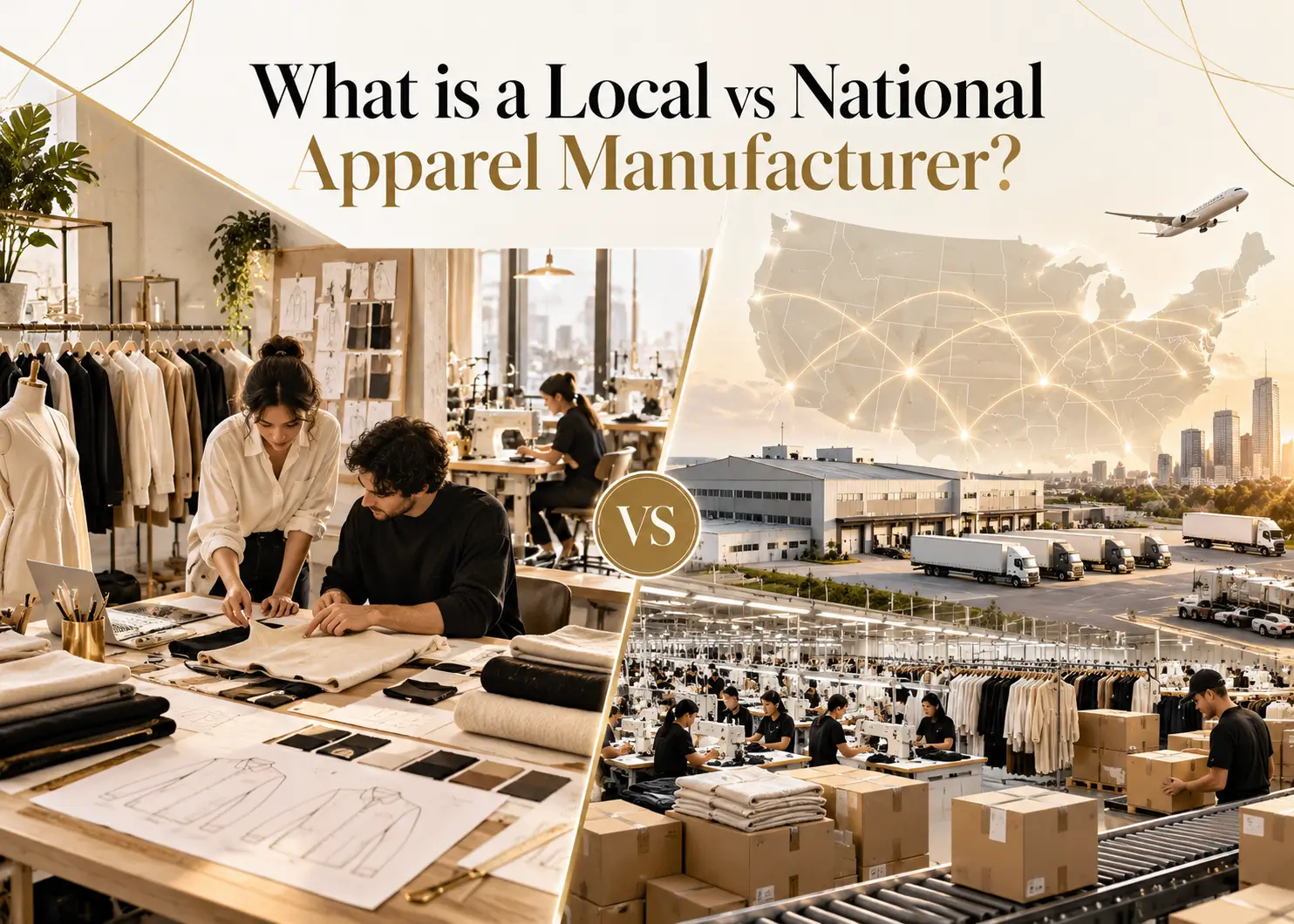
Local vs National Apparel Manufacturer: What's the Difference?
The simplest difference is location within the same country. A local manufacturer operates relatively close to your business, warehouse, design studio, or primary operating location. A national manufacturer operates elsewhere in the same country.
Both manufacturers can operate under the same national regulatory and currency environment. The main variable is distance and what that distance changes operationally.
What Is a Local Apparel Manufacturer?
A local apparel manufacturer is located relatively close to your business or operating base. The exact meaning of “local” depends on the market and the distance you consider practical for travel, shipping, and factory visits.
A nearby factory may make it easier to:
- Visit the facility
- Review samples in person
- Discuss product changes face to face
- Inspect production
These advantages depend on the actual distance, factory schedule, and manufacturing process.

What Is a National Apparel Manufacturer?
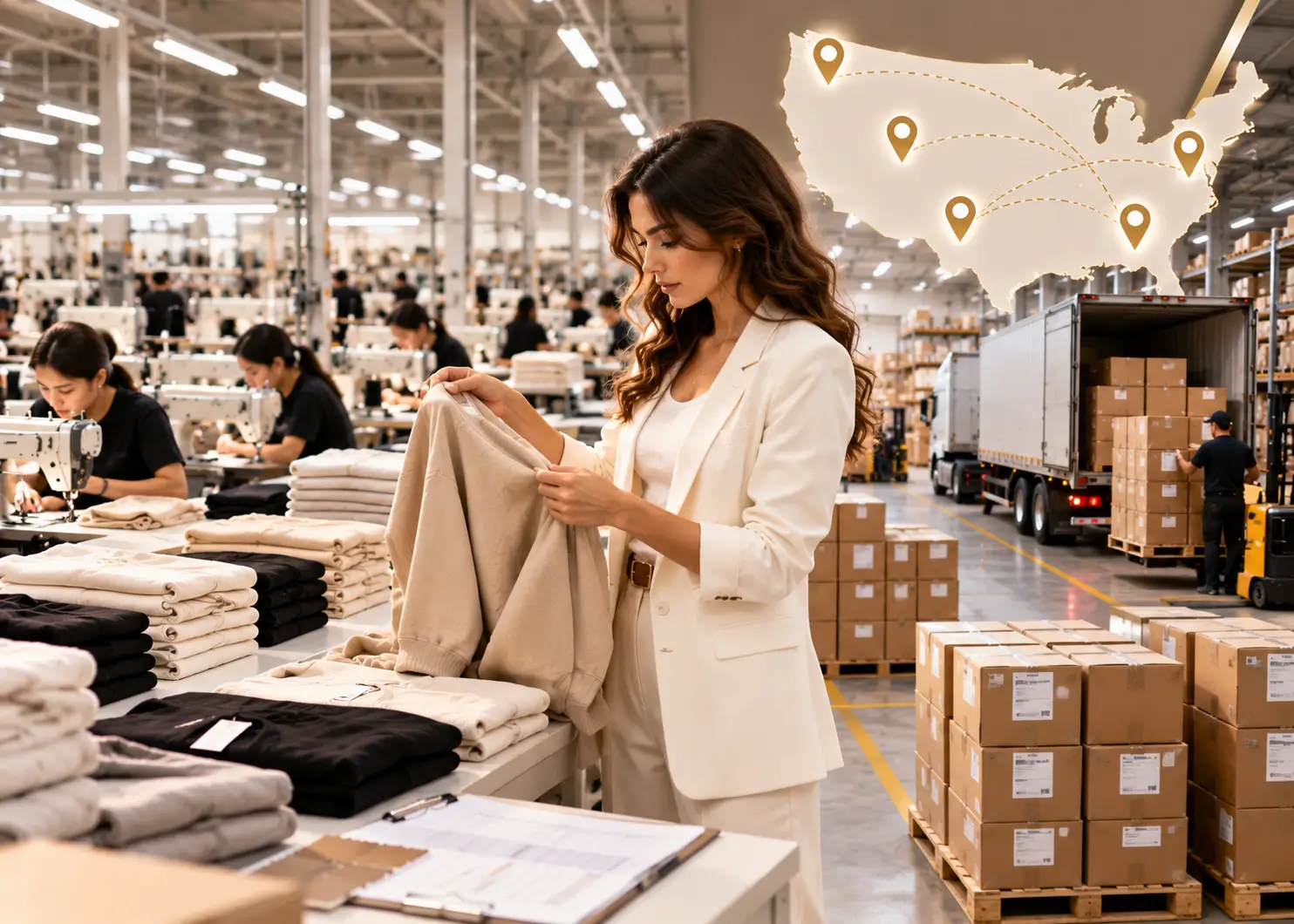
A national apparel manufacturer operates elsewhere within the same country.
The manufacturer may be farther away from your business, yet still provide domestic production without international customs, cross-border freight, currency conversion, or import procedures.
The wider geographic pool can also give you access to manufacturers with specific garment expertise, fabric sourcing relationships, machinery, or production capacity.
Why Distance Matters More Than the Label
Calling a manufacturer “local” or “national” does not tell you how suitable it is for your product.
A factory 30 miles away may lack the machinery or construction expertise your garment requires. A manufacturer several hundred miles away may have the right equipment, production team, and sourcing network.
Distance becomes relevant when it affects practical activities.
The useful comparison of Local vs National Apparel Manufacturers – is therefore distance plus manufacturing capability, not location alone.
You might also want to take a look at: Custom T-Shirt Pricing by Quantity.
Side by Side Comparison of Local vs National Apparel Manufacturers
The differences become clearer when you compare the factors that affect an actual apparel order.
Factor | Local Manufacturer | National Manufacturer |
Factory proximity | Closer to your operation | Farther away |
Factory visits | Easier to arrange in many cases | Requires more travel planning |
Sample delivery | May be faster or less expensive locally | Usually involves domestic courier or freight |
Communication | Easier to combine communication with in-person meetings | Can rely more heavily on remote communication |
Domestic shipping | May be lower depending on distance | Varies according to origin and destination |
Manufacturer selection | Limited by nearby availability | Larger geographic supplier pool |
Specialization | Depends on the local manufacturing ecosystem | May provide access to regional specialists |
Production capacity | Depends on the individual factory | Potentially broader supplier options |
Reorders | Physical access may simplify urgent coordination | Depends on production schedule and freight |
Quality oversight | Physical access can make visits easier | Inspections require more planning |
Scalability | Depends on factory capacity | Wider supplier pool may provide more options |
Travel requirements | Generally lower | Potentially higher |
These are operating differences, not guarantees. A national manufacturer can have excellent communication and fast sampling, while a local manufacturer can have limited capacity. The manufacturer’s actual process matters more than its geographic label.
How Manufacturer Location Affects Apparel Cost
Location affects some costs associated with an apparel project, but it does not determine the factory’s production price by itself.
When comparing two manufacturers – Local vs National Apparel Manufacturers, consider the complete order cost instead of looking only at the quoted unit price.
Production: Fabric, labor, garment complexity, quantity, branding, and finishing requirements can change the factory price.
Freight: Distance between the manufacturer, suppliers, and your warehouse can affect shipping costs.
Sampling: A nearby factory may make sample reviews and revisions easier, while remote manufacturers can manage them through courier services and technical communication.
Travel: Factory visits and inspections may cost more when the facility is farther away.
Packaging & Delivery: Custom packaging, labels, finishing, and delivery requirements can add to the total order cost.

Total Order Cost vs Unit Price
A lower quoted unit price does not automatically mean a lower total project cost.
Consider:
Production + sampling and development + domestic freight + travel or inspections + packaging + delivery + other applicable project costs
The actual comparison depends on the same product specification being priced by both manufacturers.
Local vs National Manufacturers for Sampling
Sampling can make geographic proximity more noticeable because product development often involves several rounds of physical review.
A typical development sequence might look like:
First sample → fit review → pattern adjustment → second sample → approval
Each additional round can involve sample shipping, technical comments, measurements, and production adjustments.
Developing a New Garment
Consider a brand developing a fitted jacket for the first time.
The first sample may reveal that:
- The sleeve needs adjustment
- The body needs more room
- The pocket position needs to change
- The fabric weight needs adjustment
- The zipper needs to change
- The lining needs revision
Those changes can lead to another sample and another review.
A nearby manufacturer may make in-person discussions and physical sample reviews easier. A national manufacturer can still support the same development process through courier shipments, measurement specifications, technical documents, photographs, video calls, and documented feedback.
The better option depends on how much development interaction the product requires.
Fabric and Manufacturing Capabilities Matter More Than Location
A manufacturer should be evaluated against the garment you need to produce.
This becomes particularly important when your product uses specialized materials or complex construction.
Consider whether the manufacturer can work with:
- Knit fabrics
- Woven fabrics
- Different GSM requirements
- Stretch materials
- Specialty fabrics
- Custom colors
- Dyeing requirements
- Specific trims
- Complex construction
- Specialized finishing
Fabric sourcing also matters. A manufacturer may be geographically close yet unable to source the material required for your product efficiently.
The same applies to machinery and construction expertise.
A nearby factory that cannot produce your garment specification may create more development problems than a national manufacturer with the right production capabilities.
Local vs National Manufacturers for Different Apparel Products
The right manufacturing criteria can change with the product.
A basic T-shirt has different production requirements from a structured jacket or technical activewear garment. Location should therefore be considered alongside the actual construction and material requirements.
T-Shirts and Basic Knitwear
For a basic T-shirt, evaluate:
- Fabric composition
- GSM
- Neckline construction
- Fit
- Sleeve construction
- Stitching
- Labels
- Printing or embroidery
- Finishing
Sampling may be relatively straightforward when the design uses familiar construction.
Hoodies and Sweatshirts
Hoodies and sweatshirts can involve more construction variables, including:
- Fleece or other fabric type
- GSM
- Hood construction
- Kangaroo or other pocket designs
- Ribbing
- Drawcords
- Panels
- Fit
- Branding
The manufacturer’s ability to handle the required fabric and construction should be part of the evaluation.
Activewear
Activewear can require specific fabric performance, stretch, construction, finishing, and fit considerations. Evaluate the manufacturer’s experience with the materials and construction your product requires.
Outerwear and Jackets
Jackets can introduce additional components such as:
- Multiple panels
- Linings
- Zippers
- Pockets
- Trims
- Interlinings
- Specialized finishing
A more complex garment makes factory capability especially important.
Uniforms and Workwear
Uniform and workwear projects can involve larger quantities, repeat orders, multiple sizes, branding, and specific durability requirements.
Consider whether the manufacturer can maintain consistent specifications across repeated production runs.
Complex Cut-and-Sew Garments
Complex cut-and-sew products can require detailed pattern development, multiple construction operations, specialized machinery, and tighter specification control.
For these products, manufacturing capability deserves close attention alongside geographic proximity.
Local vs National Manufacturer for a New Clothing Brand
A new clothing brand often has different manufacturing priorities from an established company.
Consider:
- Development stage
- Available budget
- Initial quantity
- Sampling requirements
- Product complexity
- Launch timeline
- Inventory risk
- Communication needs
A brand developing its first garment may need several rounds of sampling and fit revisions. In that situation, the convenience of physical access can have practical value.
Another new brand may have a complete tech pack, an established specification, and a straightforward production requirement. It may place greater emphasis on MOQ, production capability, and total order cost.
The right evaluation depends on the project, not simply the brand’s age.
Local vs National Manufacturer for an Established Brand
Established brands often have different priorities because they may manage repeat production, multiple SKUs, larger quantities, and regular replenishment.
Consider:
- Repeatability
- Production capacity
- Quality consistency
- Cost structure
- Multiple SKUs
- Replenishment speed
- Production planning
- Supplier diversification
- Material availability
An established brand may need a manufacturer that can reproduce approved specifications consistently across multiple production cycles.
The ability to scale can become more important than physical proximity.
Common Mistakes When Choosing Between Local and National Manufacturers
Choosing between a local and national apparel manufacturer involves more than comparing locations. Distance can affect communication, shipping, sampling, and factory visits, but it does not determine manufacturing quality, capability, or overall cost.
The more reliable approach is to evaluate each manufacturer against the same product specifications and production requirements. Look beyond geography and unit price to factors such as MOQ, sampling, capacity, quality control, logistics, and reorder capability.
- Choosing Based Only on Distance
A nearby factory may offer easier communication, but proximity does not guarantee the right technical capabilities, equipment, or garment expertise. Verify that the manufacturer can meet your actual specifications.
- Choosing Based Only on Unit Price
A low unit price may exclude sampling, packaging, freight, or other project costs. Compare complete quotations based on identical specifications.
- Assuming Local Means Higher Quality
Quality depends on materials, specifications, production processes, workmanship, inspection, and consistency, not the manufacturer’s location.
- Assuming National Means Cheaper
A national manufacturer may have different freight or travel costs, but its production price can be higher, lower, or similar. Compare the total order cost.
- Ignoring Freight and Sample Logistics
Include domestic freight and sample shipping when calculating the project cost. Multiple sample revisions can also affect both the development timeline and budget.
- Ignoring Factory Specialization
Evaluate whether the factory has experience with your garment type, fabrics, construction methods, machinery, finishing, and branding requirements.
- Ignoring MOQ by Style and Color
Confirm how MOQ applies to each style, color, fabric, and other production variables. An overall order quantity may not satisfy every MOQ requirement.
- Failing to Inspect Samples
Before bulk production, check the approved sample against the specification, including fit, measurements, fabric, construction, branding, decoration, and finishing.
- Failing to Confirm Production Capacity
Confirm that the manufacturer can handle your required volume and production schedule. Ask how it manages future increases in demand and repeat orders.
- Not Planning for Reorders
Discuss whether the manufacturer can reproduce approved garments consistently, including materials, colors, trims, measurements, and construction details.
- Comparing Different Specifications
Only compare quotes that cover the same requirements. Differences in fabric weight, construction, branding, packaging, or finishing can make unit prices misleading.
Your Next Choice: Local vs National Apparel Manufacturers?
The right custom clothing manufacturer should fit your product requirements, production volume, development process, timeline, and future plans. Location is one part of that decision.
If you’re comparing a nearby factory with a manufacturer elsewhere in the country, start with the garment itself.
Define the specifications, quantity, materials, branding, packaging, and delivery requirements, then compare local vs national apparel manufacturers against the same production brief.
Looking for an apparel manufacturing partner? Contact Innovate Apparel to discuss your product requirements and request a custom manufacturing quote.