
Ordering 50 custom T-shirts can produce a very different unit price from ordering 500. Quantity plays a major role, but it only tells part of the story.
The garment itself affects your quote. So do the fabric, GSM, fit, construction, decoration method, artwork, number of colors, print locations, packaging, shipping, and production requirements.
That makes custom T-shirt pricing by quantity easier to understand when you look at the entire manufacturing cost instead of focusing on the shirt price alone.
In this guide, you’ll see how 50, 100, and 500-unit orders typically differ, what goes into a bulk T-shirt cost breakdown, which specifications increase your price, and how to compare apparel manufacturing quotes accurately.
A Quick Peek at Custom T-Shirt Pricing by Quantity
Order Quantity | Typical Unit-Pricing Pattern | Main Cost Effect |
50 T-shirts | Higher cost per shirt | Setup and preparation costs affect fewer units |
100 T-shirts | Lower unit cost in many cases | Production and setup costs spread across more units |
500 T-shirts | Often lower unit cost | Larger production runs can improve manufacturing efficiency |
These patterns describe common pricing behavior. They do not represent a universal price list.
For an accurate quote, the manufacturer needs your actual specifications.
Request a custom T-shirt quote based on your quantity, garment, fabric, decoration, and delivery requirements.
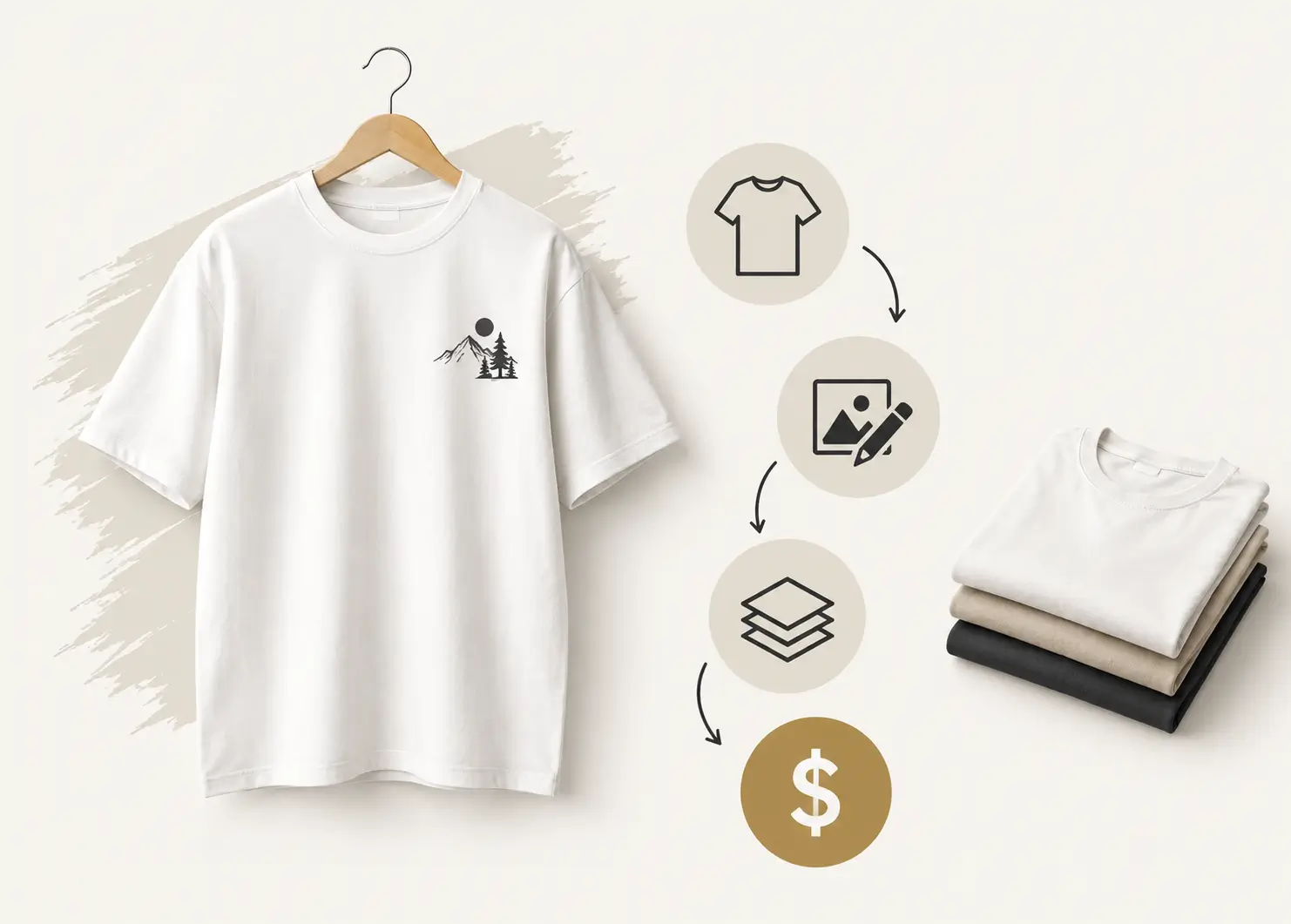
How Custom T-Shirt Pricing Works
A custom T-shirt quote usually combines several cost categories.
A simple way to understand the calculation is:
Total Order Cost = Garment Cost + Decoration + Artwork/Setup + Finishing + Packaging + Shipping + Applicable Taxes or Duties
Then:
Cost Per Shirt = Total Order Cost ÷ Order Quantity
This explains why two suppliers can quote different prices for what appears to be the same T-shirt.
One supplier may use a different fabric weight. Another may include individual packaging. A third may quote front and back printing separately.
When comparing suppliers, look at the complete delivered cost and the specifications behind it.
How Much Do 50 Custom T-Shirts Cost?
A 50-piece order sits in the smaller production range for many apparel manufacturers. That can increase the per-shirt cost because certain preparation expenses get distributed across fewer garments.
The final price still depends on the product specifications.
What affects a 50-shirt order?
A manufacturer may consider:
- T-shirt fabric
- Fabric composition
- GSM
- Garment construction
- Fit
- Size range
- Blank garment or custom-made garment
- Printing method
- Embroidery requirements
- Number of colors
- Artwork complexity
- Print size
- Number of decoration locations
- Artwork preparation
- Setup requirements
- Packaging
- Finishing
- Shipping destination
- Production timeline
- Rush requirements
- Applicable taxes or duties
A simple one-location print on a standard garment can have a very different cost structure from a heavyweight custom T-shirt with multiple decoration locations.
Why can 50 shirts have a higher unit cost?
Some production expenses remain relatively stable regardless of whether you order 50 or 500 pieces.
Artwork preparation provides a useful example.
Suppose a design requires digitization, color separation, screen preparation, sampling, or another form of pre-production work. That preparation affects the order even though the manufacturer produces each shirt individually.
With 50 shirts, those costs influence fewer units.
With a larger production run, the same preparation can spread across more garments.
This distinction between fixed or setup-related costs and variable production costs helps explain bulk pricing.
How Much Do 100 Custom T-Shirts Cost?
Moving from 50 to 100 shirts can change the economics of an order because production, preparation, and purchasing become more efficient in many cases.
The improvement does not come from quantity alone.
The manufacturer may also gain efficiencies from:
- Larger garment purchases
- More efficient cutting and production
- More efficient printing runs
- Better allocation of setup costs
- Fewer interruptions during production
- Consolidated packaging
- More efficient shipping arrangements
50 vs 100 T-Shirts
Cost Factor | 50 Units | 100 Units |
Setup cost per shirt | Higher impact | Lower impact |
Garment purchasing | Smaller volume | Greater volume |
Production efficiency | More limited | Often improves |
Decoration run | Smaller run | Larger run |
Unit-cost potential | Higher | Often lower |
A 100-piece order can make sense for a clothing brand preparing a small collection, an event organizer, a company ordering staff apparel, or a business testing demand before moving into larger production.
The key is to compare the incremental cost of ordering more units with your expected demand.
If doubling the order only adds a relatively small amount to the overall budget while substantially reducing the unit cost, the additional inventory may have a practical business case.
How Much Do 500 Custom T-Shirts Cost?
A 500-piece order gives manufacturers more room to optimize production.
At this volume, manufacturers may achieve greater efficiency through:
- Larger fabric or garment purchases
- More efficient cutting
- Longer production runs
- Better decoration efficiency
- Lower setup impact per unit
- Consolidated packaging
- More efficient logistics
- Planned production scheduling
This often creates a lower unit cost than a small order.
However, 500 shirts can also represent a significant total investment.
If you choose premium fabric, heavyweight construction, multiple decoration locations, complex artwork, specialty finishing, or individual packaging, your total order value can increase substantially.
50 vs 100 vs 500 T-Shirts
Factor | 50 Units | 100 Units | 500 Units |
Setup cost per unit | High impact | Moderate impact | Lower impact |
Production scale | Small | Medium | Large |
Bulk purchasing potential | Limited | Better | Greater |
Decoration efficiency | Limited | Improved | Stronger potential |
Inventory commitment | Low | Moderate | High |
Unit-cost potential | Higher | Lower | Often lowest |
The important question becomes:
How much inventory do you actually need?
A lower unit price does not automatically create better economics if the additional shirts remain unsold.
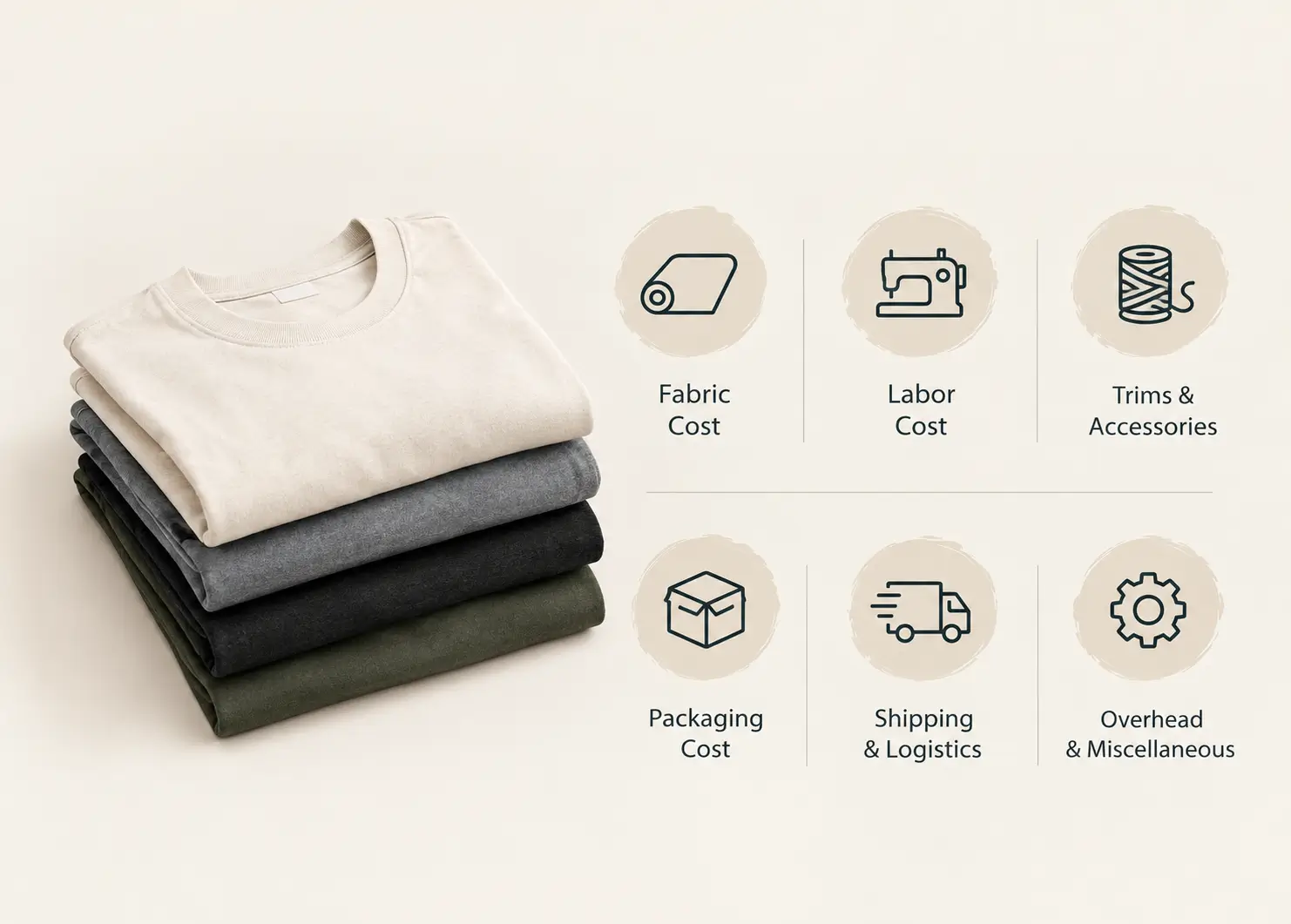
Bulk T-Shirt Cost Breakdown
When sourcing bulk T-shirts through Innovate Apparel, don’t compare suppliers on the garment price alone. Your final cost depends on the fabric, construction, decoration, finishing, packaging, and delivery requirements.
Blank T-Shirt Cost
The base garment can vary significantly depending on fabric composition, GSM, yarn quality, knit construction, fit, pattern, garment weight, sewing, and finishing.
Rough manufacturing benchmark: basic custom cotton T-shirts may start around $3–$5 per piece, while premium heavyweight or highly customized garments can reach $6–$12+ in larger production runs.
Fabric Composition & GSM
100% cotton, cotton/polyester blends, polyester, tri-blends, and specialty fabrics have different costs and performance characteristics. GSM also matters because heavier fabrics generally require more material.
As a rough guide, 160–180 GSM T-shirts typically cost less than 220–280+ GSM heavyweight styles. Always compare quotes using the same fabric composition, GSM, and construction.
Printing & Decoration
Your decoration method can significantly change the unit price:
- Screen printing: roughly $0.30–$1.50+
- DTF: roughly $0.80–$2.50+
- DTG: roughly $2–$5+
- Embroidery: roughly $0.50–$3+ for common designs
Artwork size, color count, print locations, stitch count, garment type, and order quantity can move these ranges considerably.
Artwork & Setup
Some suppliers include artwork preparation, screen setup, digitization, sampling, and proofing in the decoration price, while others charge separately. Confirm these costs before comparing quotations.
Print Locations & Size
A left-chest logo costs differently from full-front, back, and sleeve decoration. Larger artwork also consumes more materials and production time. Include the exact print size and every decoration location in your RFQ.
Labels, Packaging & Finishing
Budget separately for woven or printed labels, hang tags, barcodes, folding, polybags, stickers, and retail-ready packaging. These requirements can add roughly $0.20–$1+ per garment, depending on the specification.
Shipping & Landed Cost
Your final cost also includes freight, duties, taxes, customs charges, rush fees, and special handling where applicable. For an accurate bulk quote, Innovate Apparel can calculate the complete cost based on your fabric, GSM, quantity, decoration, labels, packaging, and delivery requirements rather than giving you a generic T-shirt price.
Rough Bulk T-Shirt Cost Estimate
These are rough manufacturing benchmarks. Actual costs vary with fabric specification, GSM, quantity, artwork, decoration, customization, packaging, destination, and order requirements.
Cost Component | Rough Cost per T-Shirt |
Basic cotton T-shirt | $3–$5 |
Premium/heavyweight T-shirt | $6–$12+ |
Screen printing | $0.30–$1.50+ |
DTF printing | $0.80–$2.50+ |
DTG printing | $2–$5+ |
Embroidery | $0.50–$3+ |
Labels & basic packaging | $0.20–$1+ |
Typical total for a basic custom T-shirt | $4–$8+ |
Premium/heavyweight custom T-shirt | $7–$15+ |
For the best custom t-shirt quotations, reach out to Innovate Apparel, and you will be pleased with our services.
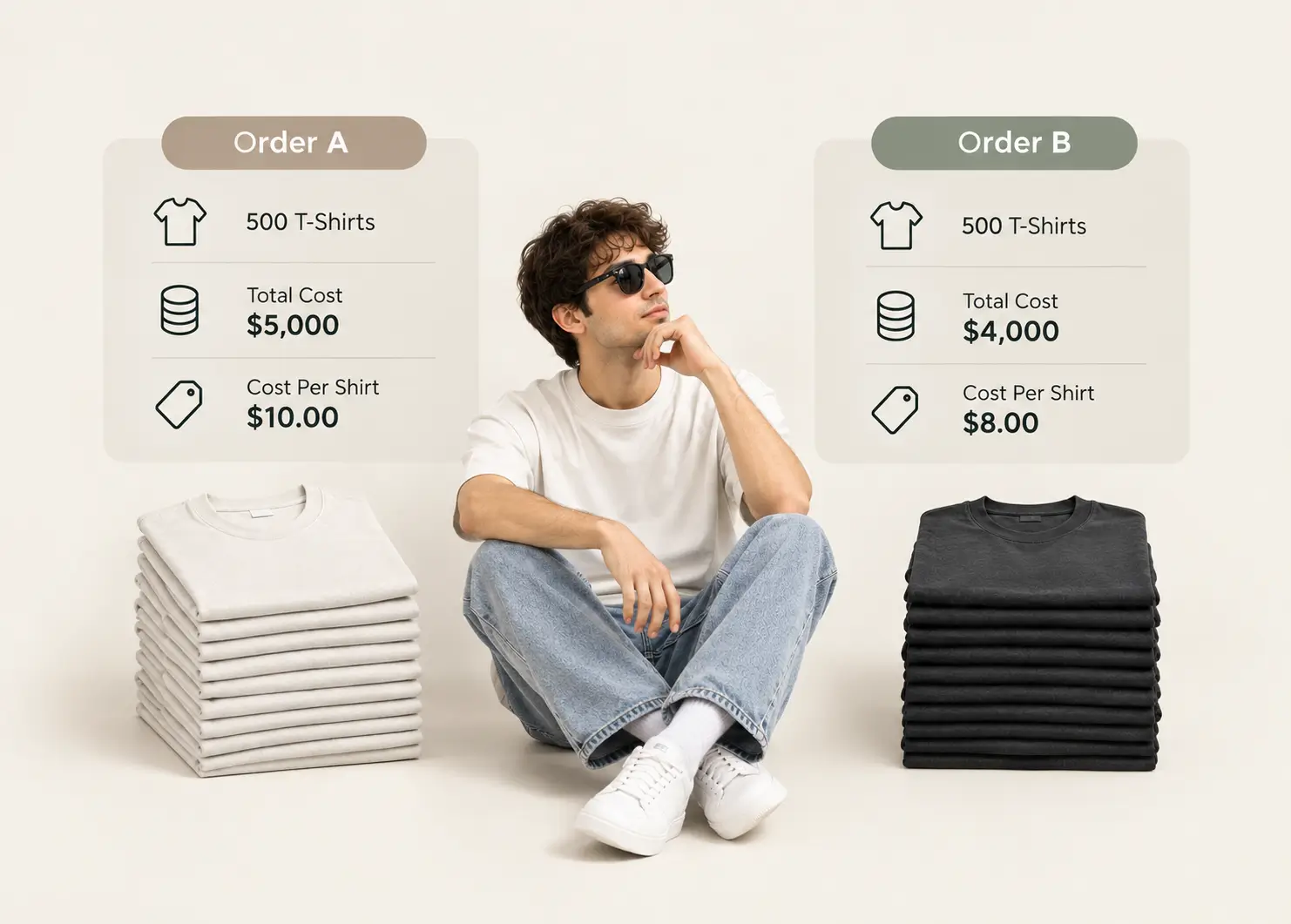
Does Ordering 500 T-Shirts Always Cost Less Per Shirt?
Higher quantities reduce the unit cost by a lot.
But a 500 piece order can still cost more per shirt if you introduce more expensive specifications.
For example, consider two hypothetical orders:
Order A
- 500 standard T-shirts
- One decoration location
- Simple artwork
- Standard packaging
Order B
- 500 heavyweight premium T-shirts
- Front and back printing
- Sleeve embroidery
- Custom labels
- Individual packaging
- Specialty finishing
Both orders contain 500 garments, but their manufacturing requirements differ substantially.
Quantity creates scale. Product specifications determine what that scale applies to.
That’s why a manufacturer needs the complete specification before providing a meaningful bulk quote.
Custom T-Shirt Pricing by Printing Method
The decoration method affects both your production cost and final T-shirt price. For apparel brands sourcing through Innovate Apparel, the following ranges can serve as rough manufacturing benchmarks. Actual quotes vary by garment quality, artwork, quantity, placement, and order specifications.
Screen Printing
Screen printing is generally cost-effective for larger runs. Rough decoration cost: $0.30–$1.50 per T-shirt for standard designs, depending on colors, print size, locations, setup, ink, and quantity. Larger orders typically reduce the per-piece cost as setup expenses spread across more garments.
Direct-to-Garment (DTG)
DTG works well for detailed, multicolor artwork and smaller production runs. Rough decoration cost: $2–$5 per T-shirt, depending on print area, artwork, garment, machine, and production volume.
DTF Printing
DTF creates a printed transfer that gets heat-applied to the garment. Rough decoration cost: $0.80–$2.50 per T-shirt for many standard applications, with artwork size, transfer coverage, garment type, and quantity affecting the final quote.
Embroidery
Embroidery creates a raised, stitched finish and works particularly well for logos and premium apparel. Rough decoration cost: $0.50–$3+ per garment for common designs. Large or dense artwork can cost considerably more because stitch count, digitization, backing, thread usage, and placement increase production time.
For accurate pricing, Innovate Apparel can quote the complete package. Contact us via form or email us for more information.
You may want to take a look at: Screen Printing vs DTG Printing Compared
50 vs 100 vs 500 T-Shirts: Which Quantity Makes Sense?
The appropriate quantity depends on demand, budget, inventory strategy, and production goals.
Quantity | Common Application | Main Consideration |
50 | Small team, test launch, limited campaign | Lower inventory commitment, higher potential unit cost |
100 | Event, staff apparel, small brand release | Balance between volume and inventory |
500 | Larger campaign, wholesale, established apparel program | Greater scale and stronger bulk-production potential |
These examples describe common scenarios.
A new brand may prefer a smaller run to validate demand.
An established apparel company may require hundreds of units to support a launch or wholesale program.
The quantity should follow your sales forecast and production plan.
Get a Quick Custom T-Shirt Pricing Quote
Custom T-shirt pricing by quantity becomes much easier to understand when you stop treating quantity as the only variable.
A 50, 100, 500, and 1000+ piece order can all produce different unit economics because manufacturing costs change with scale.
For brands planning custom apparel, the most useful comparison follows the complete path:
Garment → Fabric → GSM → Decoration → Artwork → Quantity → Production → Finishing → Packaging → Landed Cost
That framework gives you a clearer way to evaluate supplier quotes and determine which production volume fits your business.
If you’re planning a custom T-shirt collection, share your quantity, garment style, fabric requirements, GSM, artwork, decoration method, print locations, size range, and delivery destination with your apparel manufacturer. Those details allow the manufacturer to build a quote around the actual product you intend to produce.
Ready to develop your next custom T-shirt collection? Request a custom apparel manufacturing quote from Innovate Apparel.