A print on demand business lets you sell products without purchasing a large inventory before you know what customers will buy. You create the designs, choose your products, publish them through your sales channel, and work with a print on demand supplier to produce and ship orders when customers purchase them.
That model makes launching a clothing brand more accessible. You can test T-shirts, hoodies, sweatshirts, embroidered apparel, and other products with a smaller upfront inventory commitment.
Running a successful Print on Demand clothing business still requires careful planning.
This guide explains how to start a print on demand business from the ground up, with a specific focus on clothing and apparel.
What Is Print on Demand?
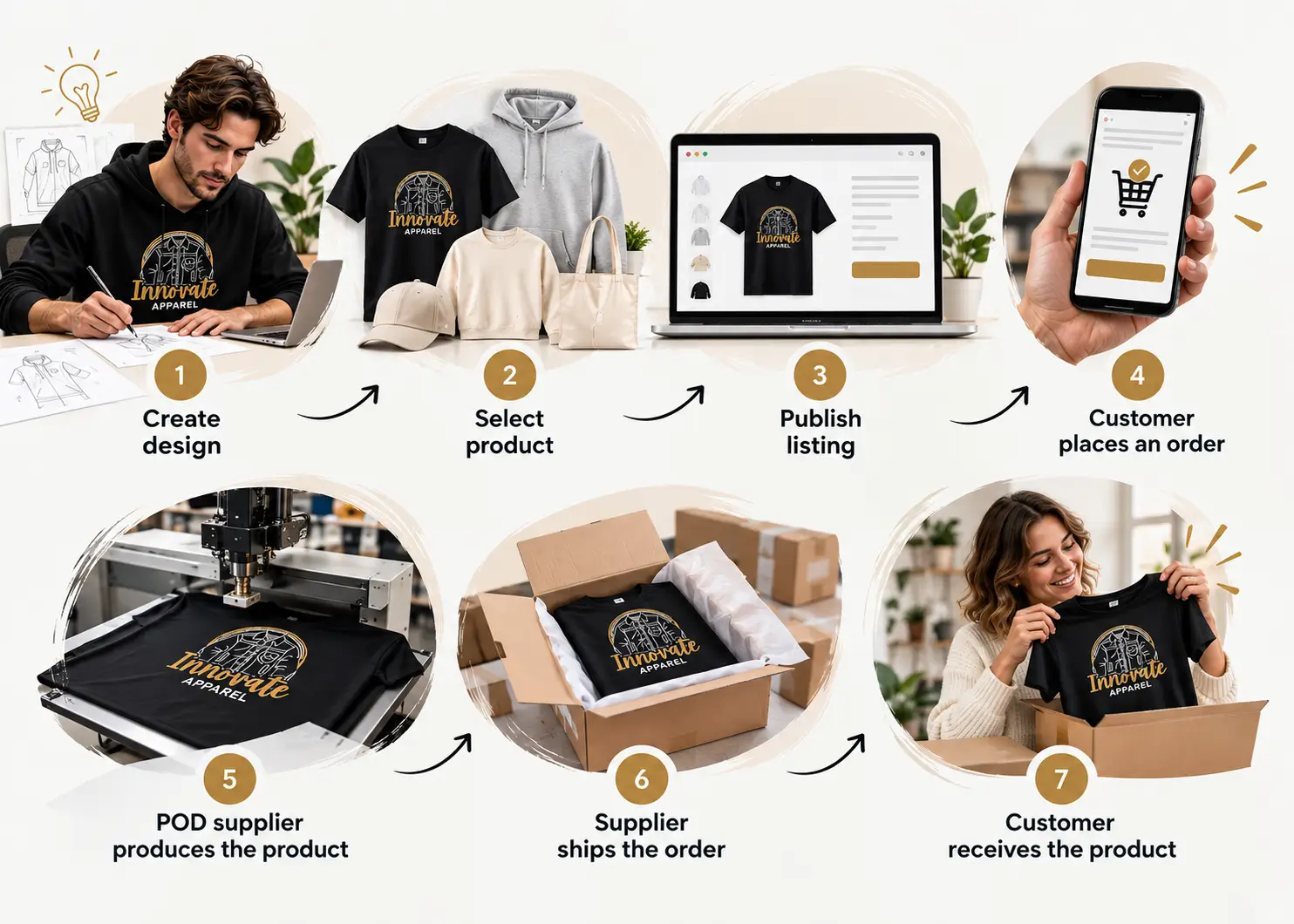
Print on demand is a business model where a supplier produces a product after a customer places an order. The supplier can print or embroider your design, prepare the product for shipment, and send it directly to the customer.
You handle the brand, product selection, designs, storefront, marketing, customer experience, and sales.
The basic model looks like this:
You pay the supplier according to the products and services included in the order. This structure reduces the amount of inventory you need to purchase before testing demand.
For apparel brands, print on demand can include products such as:
- T-shirts
- Hoodies
- Sweatshirts
- Tank tops
- Hats
- Tote bags
- Embroidered apparel
- Custom accessories
Your supplier determines the available blank garments, printing methods, fulfillment locations, production times, and shipping options. Those factors should influence your product and pricing decisions from the beginning.
Is Print on Demand a Good Business Model?
Print on demand can work well for entrepreneurs who want to test products with limited inventory commitments. It also gives clothing brands a practical way to test designs, audiences, and product concepts before investing in larger production runs.
Your business still carries costs and operational responsibilities. Supplier pricing, shipping, platform fees, payment processing, marketing, refunds, replacements, taxes, and customer acquisition can all affect profitability.
Advantages of Print on Demand
A POD business can provide several operational advantages:
- Lower upfront inventory commitment
- Lower inventory storage requirements
- Easy product testing
- Flexible product catalogs
- Simple product expansion
- Supplier-managed fulfillment
- Ability to test multiple designs
- Lower initial production commitments
- Easier experimentation with new collections
Disadvantages of Print on Demand
POD also comes with limitations:
- Higher per-unit costs
- Limited control over garment construction
- Supplier dependency
- Shipping costs
- Product quality can vary between suppliers
- Limited customization on some products
- Competition across common apparel categories
- Customer acquisition costs
- Potential fulfillment delays
- Limited control over packaging
Print on demand reduces inventory exposure. It does not remove the financial and operational risks involved in running a clothing business.
Steps to Start a Print on Demand Business in 2026
Starting a print on demand business involves more than uploading designs to a supplier. You need a clear product strategy, a defined customer, reliable production, accurate pricing, and a system for testing and improving your products.
Follow these steps to build your POD clothing business.
Step 1: Choose a Profitable Niche
Start by defining the audience you want to serve.
A niche gives your clothing business a specific customer group and helps you develop products that feel relevant to that audience. You could build around interests, professions, lifestyles, communities, hobbies, cultural themes, or specific fashion preferences.
Research the audience before creating a large collection.
Your goal is to identify an audience with a clear interest in the type of products you plan to sell.
Step 2: Choose What POD Products to Sell
Your product selection directly affects your costs, selling price, shipping, perceived value, and potential margins.
For a POD clothing business, common products include:
If you eventually want greater control over fit, fabric, branding, and construction, you can move from POD into custom t-shirt manufacturing or other forms of custom apparel production.
How to Choose the Right POD Clothing Products
Evaluate each product according to:
- Target audience
- Selling price
- Product cost
- Shipping cost
- Perceived value
- Seasonality
- Customization
- Return risk
- Product quality
- Expected contribution margin
A product can attract attention while still creating weak economics. Calculate the complete cost structure before adding it to your store.
Step 3: Create Designs Your Audience Will Buy
Your designs should connect your niche, brand identity, and product strategy.
Create a consistent visual identity across your products. Consistency helps customers recognize your brand when they encounter your products across social media, search results, marketplaces, and your online store.
Can You Use AI Designs for Print on Demand?
AI tools can help with ideation and design development, but you need to review the commercial rights associated with the tools and assets you use.
Avoid using recognizable brand logos, copyrighted characters, protected artwork, or other intellectual property without the appropriate rights.
You should also inspect AI-generated artwork for distorted text, inconsistent details, and visual defects before sending it to production.
Step 4: Choose the Right Printing Method
Your printing method affects the appearance, feel, durability, product cost, and garment compatibility of your design.
Common methods include:
Printing method | Best suited for | Key consideration |
DTG | Detailed artwork on suitable garments | Garment compatibility matters |
DTF | Versatile apparel graphics | Works across a wider range of fabrics |
Screen printing | Larger-volume production | Production economics improve with volume |
Embroidery | Logos and premium branding | Artwork and garment suitability matter |
Sublimation | Polyester and all-over designs | Fabric requirements limit applications |
Step 5: Order Samples Before You Launch
Order samples before selling a new product.
A product mockup cannot show you the actual fabric weight, fit, stitching, print feel, packaging, or shipping condition.
If you eventually move beyond POD, small batch clothing manufacturing can also let you test physical products before committing to larger production quantities.
A physical sample gives you an opportunity to evaluate the product before customers receive it.
Document any defects or inconsistencies before you launch.
Step 6: Calculate Your True POD Product Cost
When you eventually compare POD with traditional production, understand how apparel manufacturer MOQ affects your upfront investment, unit economics, and production planning.
Product cost alone does not tell you whether a POD product can generate a healthy contribution profit.
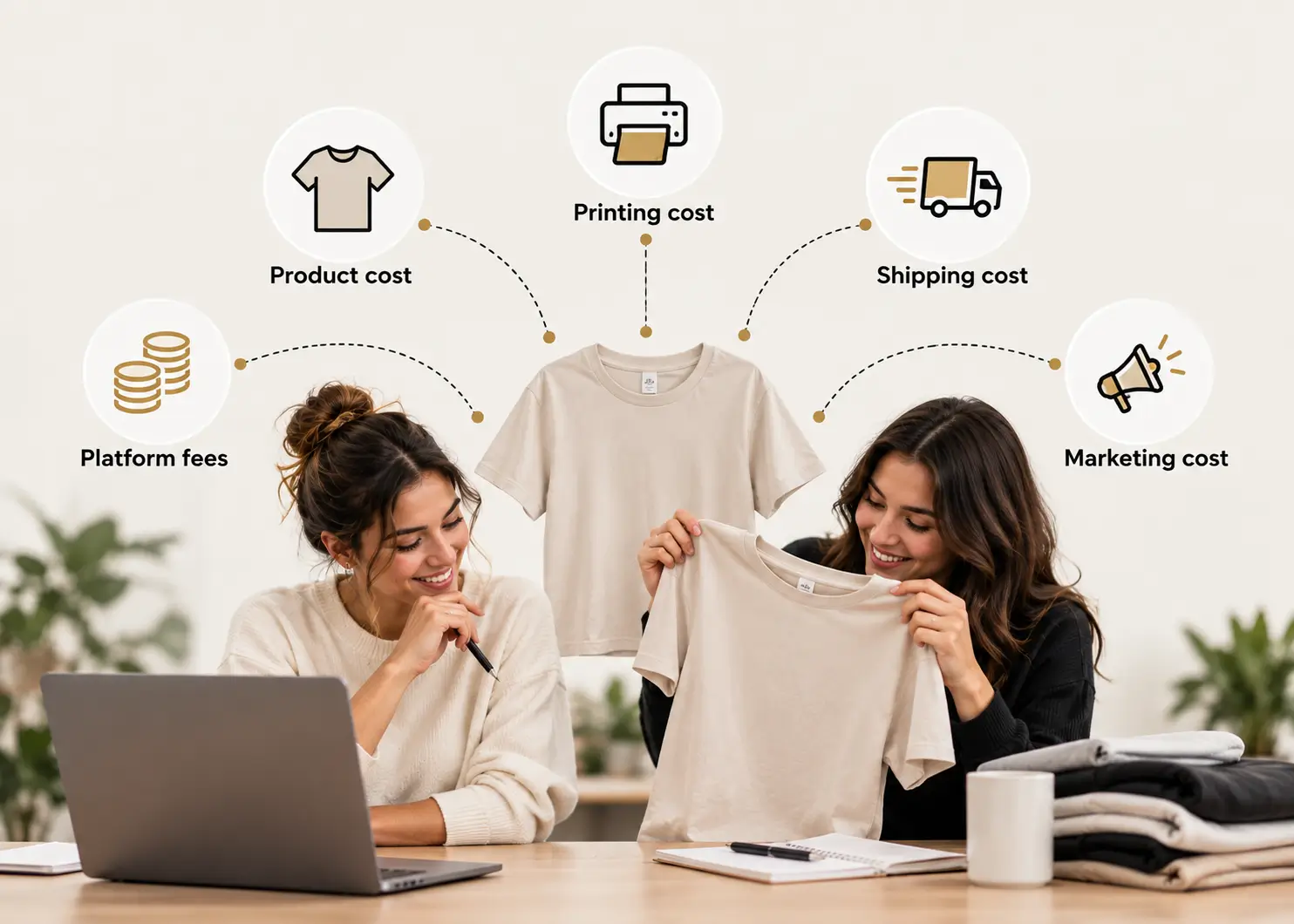
Calculate the complete cost associated with selling the product.
A simple formula is:
Product cost + printing + shipping + platform fees + payment processing + marketing + refunds/replacements = total cost
Then calculate:
Selling price − total cost = contribution profit
For example, imagine you sell a T-shirt for $30.
Your costs could include:
- Blank garment: $10
- Printing: $4
- Fulfillment: $2
- Shipping: $5
- Payment processing: $1
- Advertising allocation: $4
- Returns or replacements allocation: $1
Your total estimated cost would equal $27.
$30 − $27 = $3 contribution profit
The numbers will vary by supplier, market, product, shipping destination, platform, and advertising strategy. The example demonstrates why you need to calculate the complete economics of each product.
Include All Relevant Costs
Your calculation may also need to include:
- Marketplace fees
- Discounts
- Taxes
- Packaging
- Samples
Track these expenses so you understand how each product contributes to your business.
Step 7: Set a Profitable Price
Your retail price needs to cover your complete costs and provide enough contribution to support business growth.
Consider:
- Product cost
- Printing
- Shipping
- Competitor pricing
- Perceived product value
Cost-plus pricing gives you a starting point, but customer willingness to pay also matters.
A premium garment with high-quality artwork, strong branding, and a clear target audience can support a different price from a generic T-shirt with the same production cost.
Step 8: Choose Where to Sell
Your sales channel affects fees, control, customer acquisition, branding, and scalability.
Popular options include:
- Shopify
- Etsy
- WooCommerce
- Amazon
- TikTok Shop
- Other relevant marketplaces
How to Choose a Sales Channel
Compare:
- Upfront cost
- Platform fees
- Marketplace traffic
- Brand control
- SEO capabilities
- Payment options
- Integrations
- Customer data access
- Scalability
- Content requirements
You can also combine multiple channels as your business develops.
Step 9: Build Your POD Store
Your store should give customers enough information to understand the product before purchasing.
Set up:
- Brand name
- Domain
- Logo
- Product photography or mockups
- Product descriptions
- Size charts
- Shipping information
- Return policy
- FAQs
- Payment methods
Step 10: Launch Your First POD Collection
Your first collection does not need hundreds of products.
A focused collection makes it easier to monitor which designs, products, colors, and price points attract customers.
Consider launching with:
- 3 to 5 core products
- A limited number of design concepts
- Consistent brand identity
- Controlled color selection
- Clear product positioning
Use the initial launch as a learning period.
Track which products receive impressions, clicks, add-to-cart actions, purchases, reviews, returns, and repeat orders.
POD vs Traditional Clothing Manufacturing
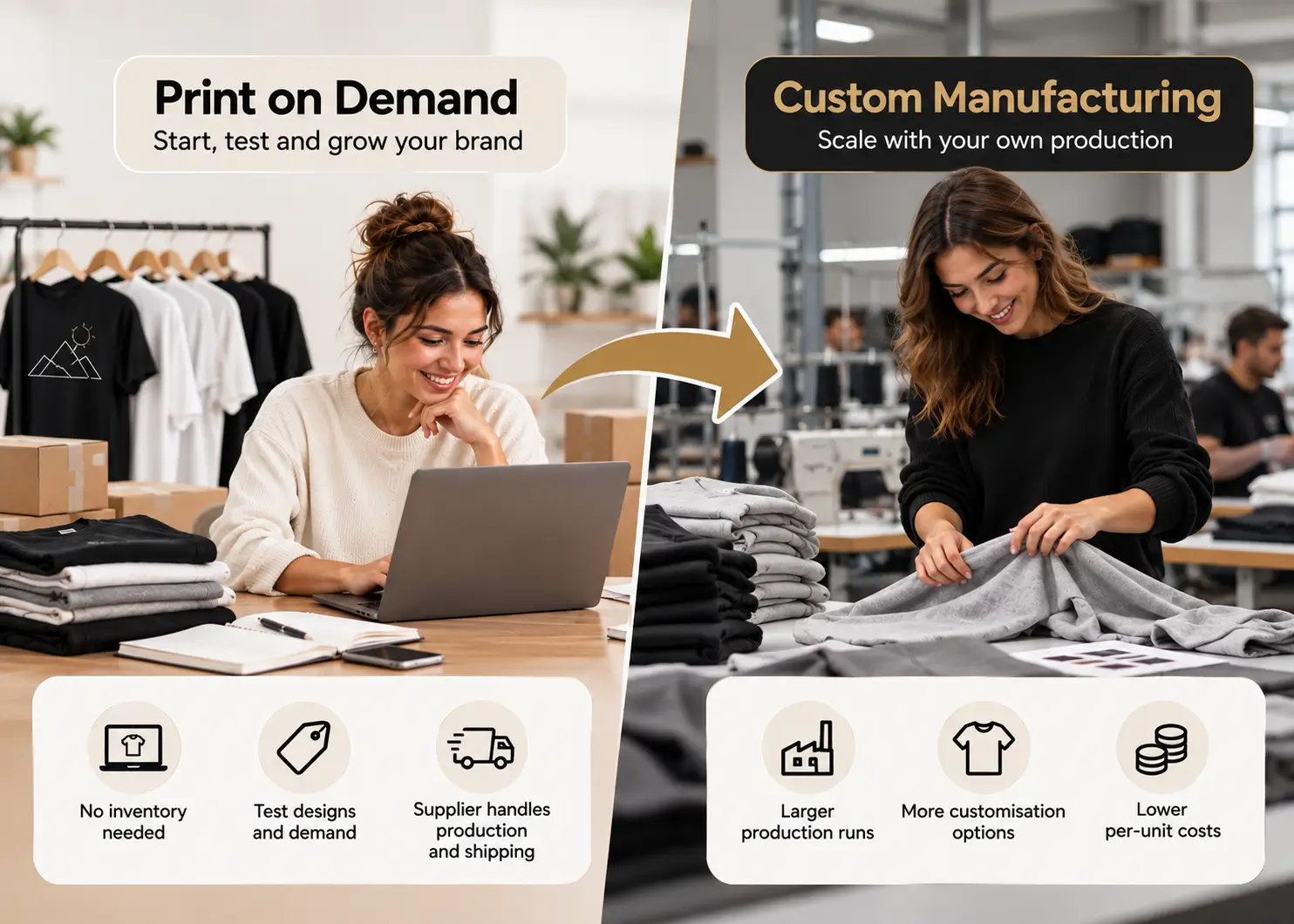
POD and traditional clothing manufacturing support different stages of an apparel business.
If you decide to move beyond POD, private label clothing manufacturing gives you greater control over fabrics, labels, packaging, garment development, and overall product specifications.
Factor | Print on Demand | Clothing Manufacturing |
Inventory | Minimal | Required |
Upfront investment | Lower | Higher |
Unit cost | Usually higher | Usually lower at volume |
Customization | Provider-dependent | Extensive |
Fabric selection | Provider-dependent | Greater control |
Labels | Provider-dependent | Custom options |
Packaging | Provider-dependent | Custom options |
MOQ | Often very low | Manufacturer-dependent |
Quality control | Provider-dependent | Greater direct control |
Product development | Limited by provider | Full control |
Best use | Testing and smaller volume | Proven products and scaling |
The right model depends on your sales volume, product requirements, available capital, desired customization, and growth stage.
How Much Does It Cost to Start a Print on Demand Business?
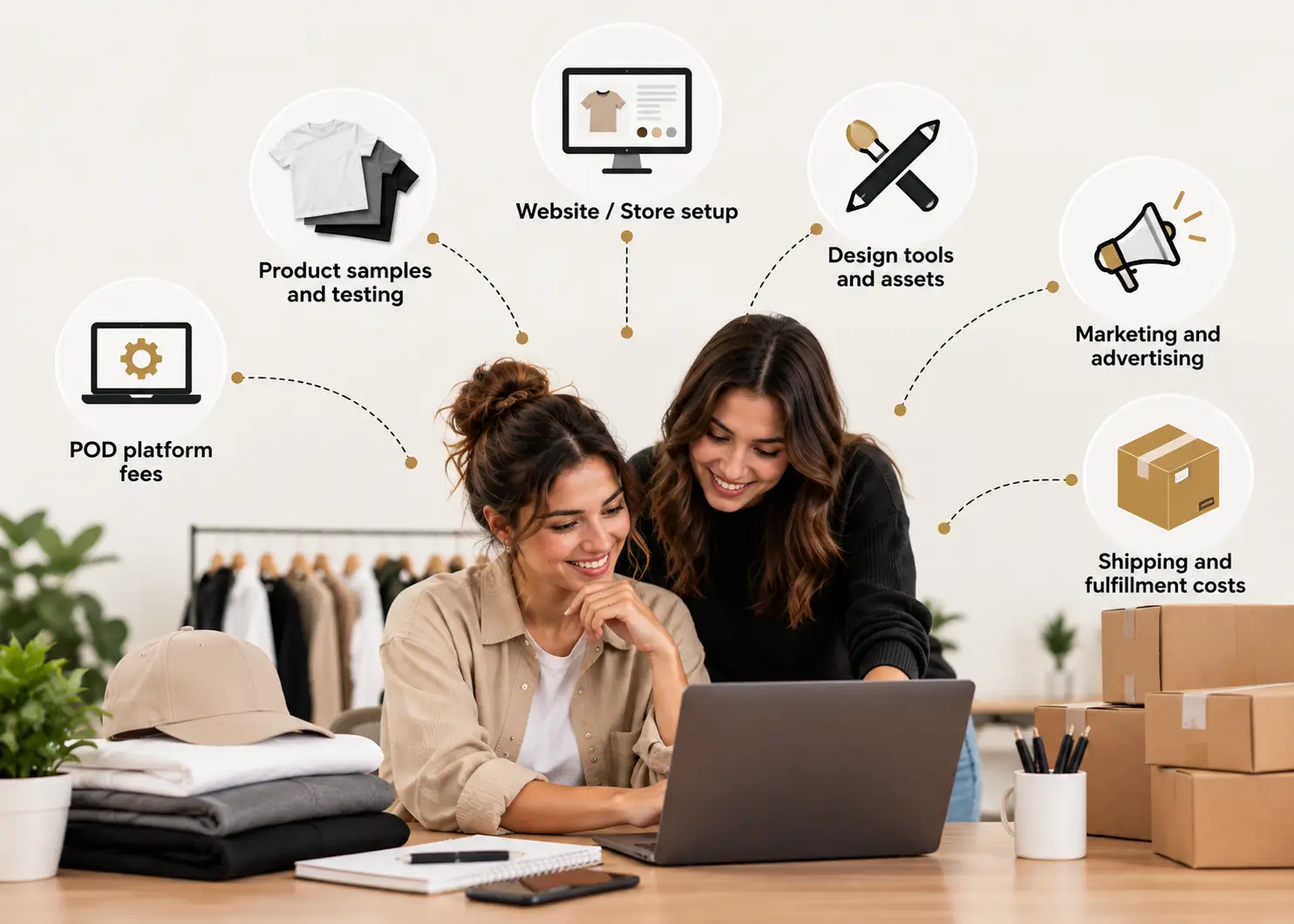
The startup cost depends on your business model, sales channel, product strategy, branding, marketing budget, and supplier.
You can divide your expenses into essential and optional categories.
Essential Costs
Potential essential expenses include:
- Domain
- Ecommerce platform
- Samples
- POD fulfillment
- Payment processing
Your exact requirements depend on the platform and supplier you choose.
Optional Costs
Additional expenses can include:
- Professional design services
- Advertising
- Influencer campaigns
- Branding
- Packaging
Three Common Starting Approaches
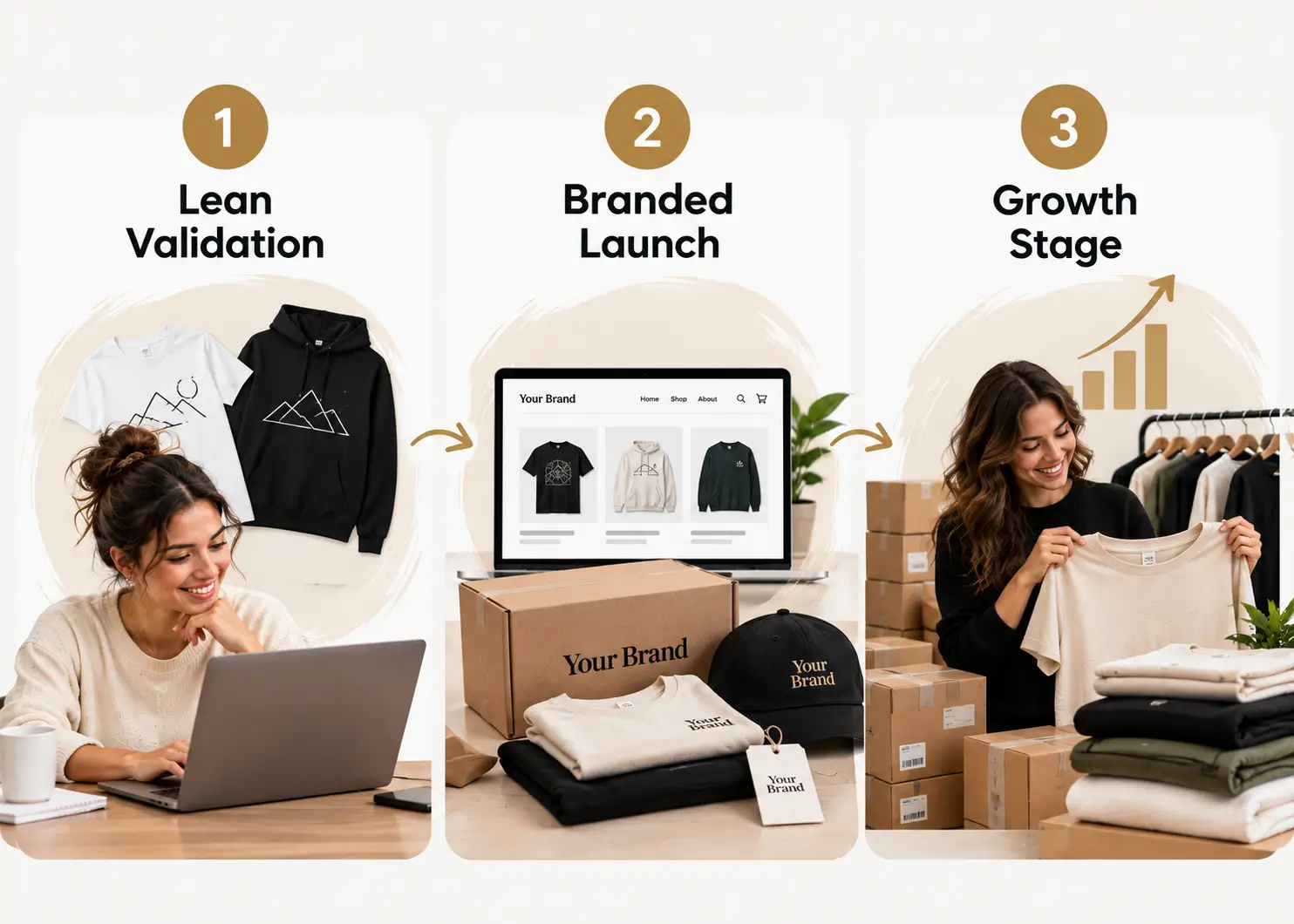
You can think about your launch in three stages:
Lean validation → Branded launch → Growth stage
A lean validation approach focuses on testing products and demand with limited spending.
A branded launch adds stronger visual identity, content, product development, and customer experience.
A growth stage can involve higher advertising budgets, more products, stronger operations, and a transition toward custom apparel manufacturing when the economics support it.
There is no universal startup budget that fits every POD business.
How to Transition From Print on Demand to Manufacturing
A practical transition can follow this sequence:
- Test the concept with POD.
- Identify products with consistent demand.
- Analyze customer feedback and product reviews.
- Define the improved garment specifications.
- Create a tech pack.
- Find a suitable clothing manufacturer.
- Request samples.
- Test the samples.
- Calculate the manufacturing economics.
- Place a controlled production order.
- Inspect the finished goods.
- Scale production as demand supports it.
This approach lets your manufacturing investment follow validated demand. If you are opting for quality private label manufacturing, you should get in touch with Innovate Apparel.
Common Print on Demand Mistakes
Many new POD entrepreneurs focus heavily on launching and overlook the economics and product-quality side of the business.
Avoid these common mistakes:
- Choosing a niche without validating demand
- Launching too many products
- Using copyrighted designs
- Choosing a supplier based only on price
- Skipping samples
- Ignoring garment quality
- Pricing from product cost alone
- Forgetting shipping costs
- Depending entirely on paid advertising
- Using generic branding
- Making unrealistic delivery promises
- Scaling a product before validating its economics
Each mistake can create unnecessary costs or make it harder to understand what actually drives your results.
Final Takeaway
Learning how to start a print on demand business involves much more than uploading a design and publishing a product.
Choose a specific audience. Validate the niche. Select products that fit your customer and economics. Create original designs. Choose the appropriate printing method. Compare POD suppliers. Order physical samples. Calculate the complete cost of every product. Set prices based on real economics. Build a focused store and launch a manageable collection.
Then measure what happens.
Track sales, conversion rates, customer acquisition costs, contribution profit, returns, fulfillment times, and repeat purchases. Use that information to identify the products worth developing further.
For an apparel brand, Print on Demand can become the first stage of a broader production strategy.
Ready to take your clothing brand to the next stage? Explore Innovate Apparel to discover apparel manufacturing solutions for your next collection.